How to Organize a Small Guest Room for Holiday Guests
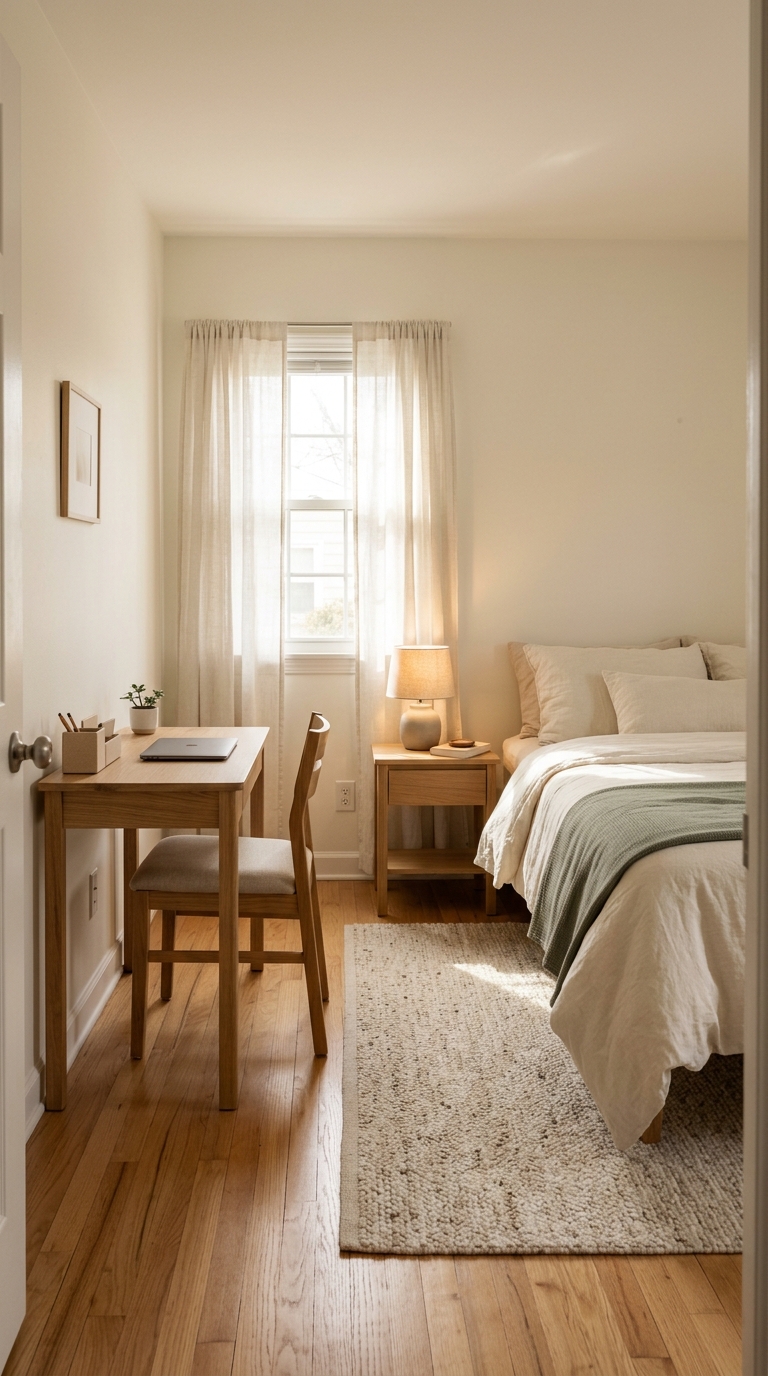
If you need to organize a small guest room before family or friends arrive for the holidays, you might already be wondering where everything is supposed to go. The bed needs clearing, your desk still has work to do, and the boxes or craft supplies you have been meaning to put away cannot simply disappear. Meanwhile, you still need the room to function after your guests leave.
You do not have to empty the entire room, buy a new bedroom set, or move half your belongings into the living room. The better approach is to prepare the room for the visit: make sleeping comfortable, create space for personal belongings, contain the room’s everyday activities, and keep the main walking routes clear.
Here are nine practical steps to help you organize a small guest room using what you already have, without creating a second organizing problem elsewhere in your home.
1. Decide What Must Stay in the Room and What Can Move
To organize a small guest room effectively, first decide what the room needs to do while your guests are there. Before moving furniture or emptying drawers, identify what must stay accessible and what can temporarily move elsewhere.
If it is your home office, the desk might have to stay. If you use it for sewing, crafting, or storing seasonal decorations, some supplies may need to remain nearby. You are not trying to turn the room into something it is not. You are making temporary space for another person.
Sort the contents into three groups:
- Keep in the room: Essential furniture and items you need during the visit.
- Relocate temporarily: Things you can use elsewhere for a few days, such as a craft basket, laundry hamper, or spare chair.
- Put away properly: Items that have accumulated without a clear purpose, such as empty boxes, packaging, or belongings that belong in another room.
Imagine that your desk is covered with paperwork and stationery. File important papers, put smaller supplies in a drawer, and place anything you still need in one container on a shelf.
If storage boxes contain items you genuinely need, group them safely rather than spreading their contents across your home. Move other boxes to a suitable storage area before guests arrive, if possible.
One important rule: Every item you move needs a temporary home. Otherwise, preparing the guest room simply transfers the clutter to your living room or hallway.
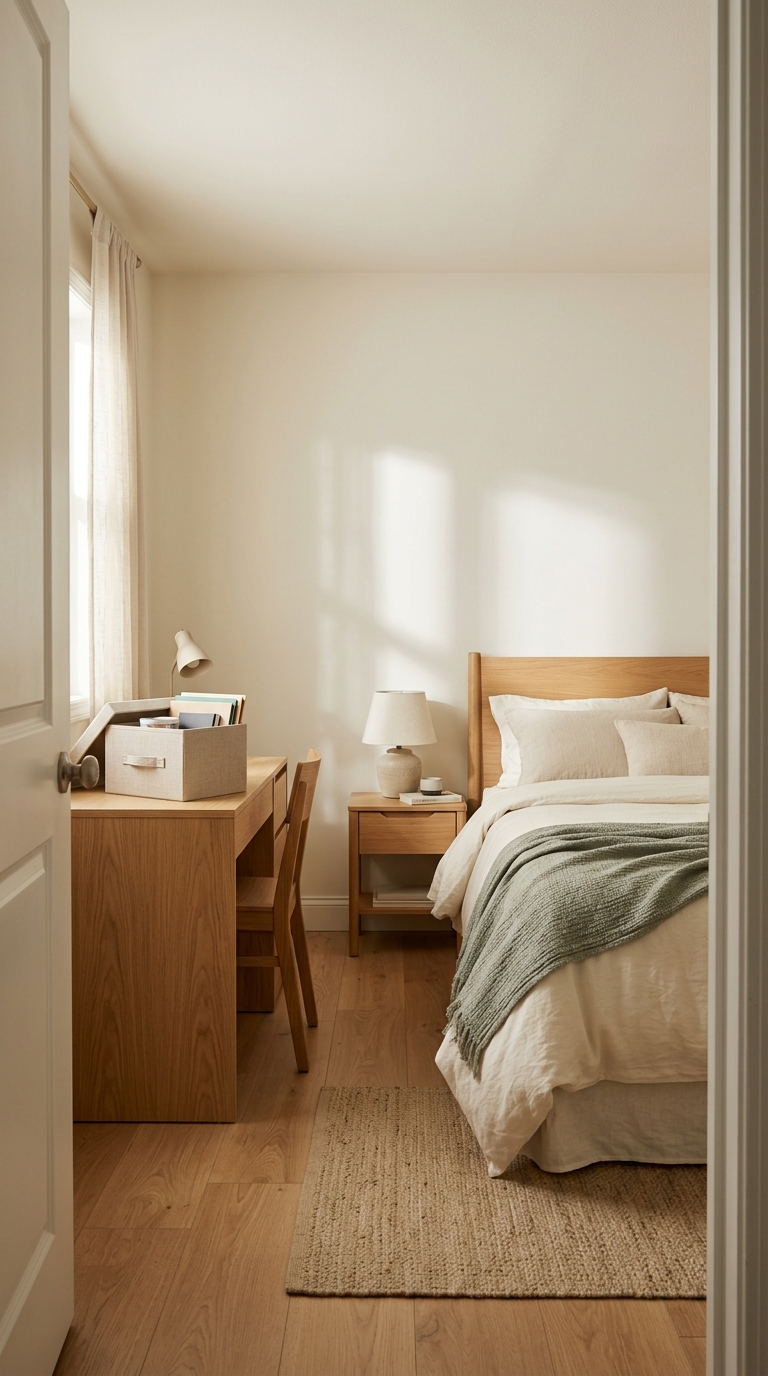
If you are struggling to find homes for everyday belongings throughout the house, our guide to organizing a small home when everything feels like it has nowhere to go can help you rethink your storage priorities.
2. Protect the Space Your Guests Actually Need
Once you know what can stay, look at the room from your guest’s point of view.
Can someone enter the room, get into bed, and reach the door without stepping over a bag or squeezing between furniture? Is there somewhere to stand while changing clothes? Can the closet open without colliding with the bed?
These questions matter more than whether every corner looks decorated.
Start with the route from the door to the sleeping area. Remove loose items, relocate unnecessary furniture, and keep doorways and exits unobstructed. Then check the space beside the bed that your guests will actually use.
You may not have enough room to walk comfortably around every side of a double or queen bed. That is a reality in some small homes. Focus on maintaining a safe, usable route rather than forcing a furniture arrangement that does not fit.
Try walking through the room yourself. Open the door fully, sit on the bed, stand up, and reach for the light. If you have to move a chair every time you do one of these things, your guests probably will too.
If the bed is already occupying most of the floor, resist the urge to add a bench, extra chair, or decorative storage unit. A little open floor space is often more valuable than another piece of furniture.

For more ideas about making existing bedroom furniture work in a compact layout, see how to organize a small bedroom without making it feel cramped.
3. Make a Small Closet or Dresser Work for Guests
Your guests do not necessarily need an empty closet. They need somewhere to put the clothes and personal belongings they bring. Clear a small, practical amount of space that suits the length of their stay; you do not need to empty every drawer or reorganize your entire wardrobe.
If you have a closet, clear a small section of the hanging rail and leave a few empty hangers. Move clothing you will not need during the visit to another suitable location, if one is available.
If there is a dresser, clear one drawer or a defined section of a drawer. That may be enough for pajamas, a few folded clothes, or other personal items.
What if your closet is already full and the dresser has no spare drawers?
Look at the storage you do have. An accessible shelf, a small basket on an existing surface, or an empty drawer in another suitable piece of furniture may work. You can also designate a small area where guests can place folded clothes rather than expecting them to unpack everything.
Think about the length of the visit. Someone staying overnight may be comfortable living out of a bag. Someone staying for five nights may appreciate a little more room to unpack.
You do not need to empty half your wardrobe for a weekend visit. Equally, asking a guest to balance all their belongings on the bed for a week is not particularly practical.
Make the available space obvious. A few empty hangers and a cleared shelf tell your guests they can use them without having to ask.
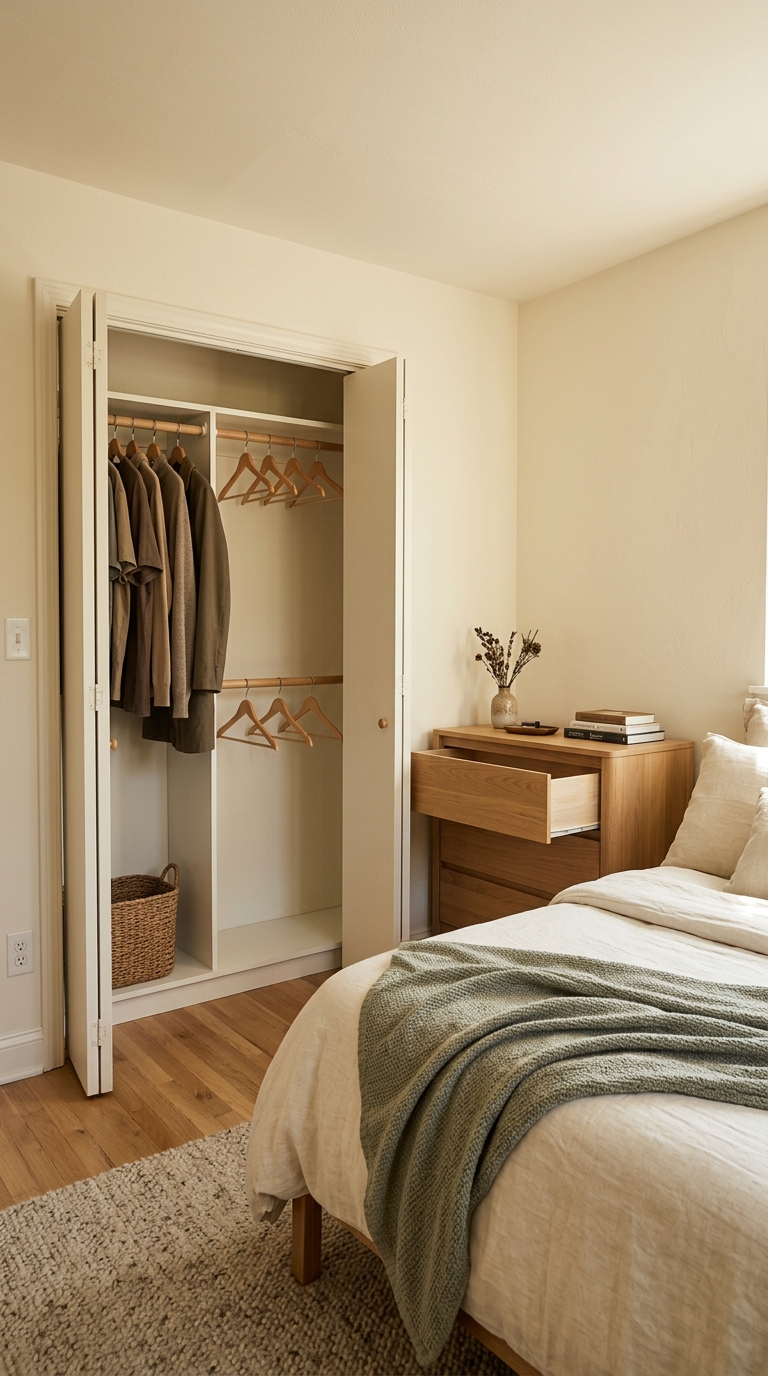
If your closet needs attention before you can make room, these fall closet organization ideas for small spaces may help you decide what to relocate.
4. Create a Landing Spot for Suitcases and Bags
Here is a small detail that can make a surprisingly big difference: decide where the suitcase will go before your guest arrives.
Without a designated spot, luggage often ends up on the bed, in front of the closet, or in the only clear walking path. Your guest then has to move it every time they need to get dressed or leave the room.
Look for an unused corner or a clear section of wall where a suitcase can stand without blocking the door, closet, or route around the bed.
If you already own a sturdy bench or luggage rack, it may work. But do not assume you need to buy one. A suitcase can often stand upright against a wall, provided it is stable and does not obstruct movement.
Think about the luggage your guest is likely to bring. A backpack needs little room. A large suitcase may need enough clearance to open fully, and that space might not be available beside the bed.
If there is no suitable place inside the room, consider whether a different furniture arrangement would help. If it would not, discuss another appropriate location with your guest before arrival.
Do not solve the problem by placing luggage in front of a door or forcing your guest to climb over it.
A practical landing spot is not necessarily a dedicated piece of furniture. It is simply a place where belongings can stay without making the room harder to use.
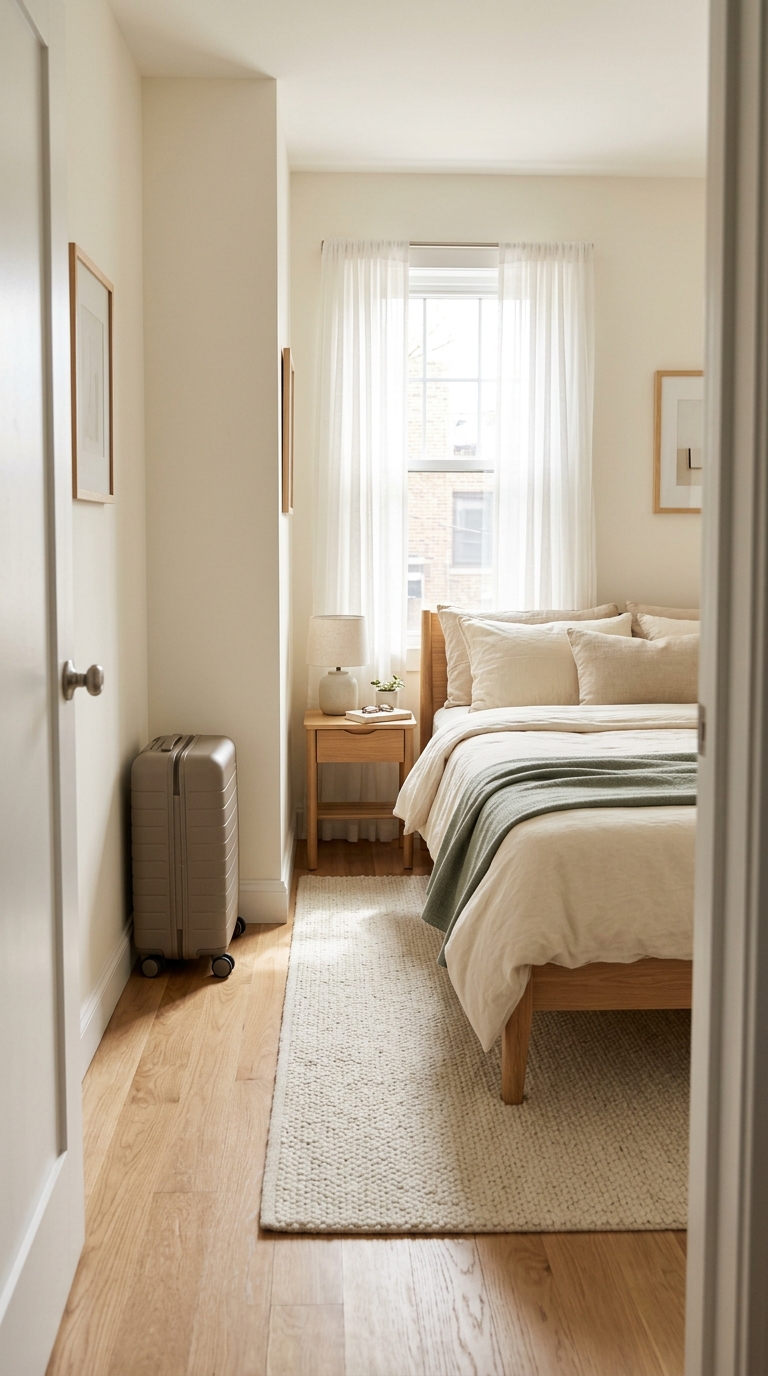
5. Contain the Room’s Everyday Job
When you organize a small guest room that doubles as an office, craft space, or storage area, the challenge is keeping its everyday purpose from taking over the sleeping space. You do not always need to move everything out. Instead, decide what must remain accessible and what can be contained temporarily.
If the room is your home office: Keep the desk if you need it, but clear unnecessary paperwork and loose supplies. Put important documents away securely, especially anything confidential. If you will need to work while guests are staying, think about when you can use the room without disturbing their sleep or privacy.
If the room is a craft space: Gather unfinished projects, fabric, thread, and other supplies into a container. Put sharp tools and small materials somewhere secure, especially if children will be visiting. You can return to the project after the room is back to normal.
If the room is used for storage: Group belongings into manageable containers and relocate only what is necessary. Avoid creating an unstable stack of boxes elsewhere just to make the guest room look better.
If the room serves several purposes: Keep the items you genuinely use together and remove the things that interfere with sleeping, dressing, or moving around.
You may not be able to hide the desk or make every trace of your hobbies disappear. That is fine. A neat desk is not a problem simply because it looks like a desk.
The goal is to keep the room’s everyday function contained rather than allowing it to spill into the sleeping area.
Before your guests arrive, decide which items need to stay accessible and which can remain packed away until their visit ends. That small decision will make restoring the room much easier later.
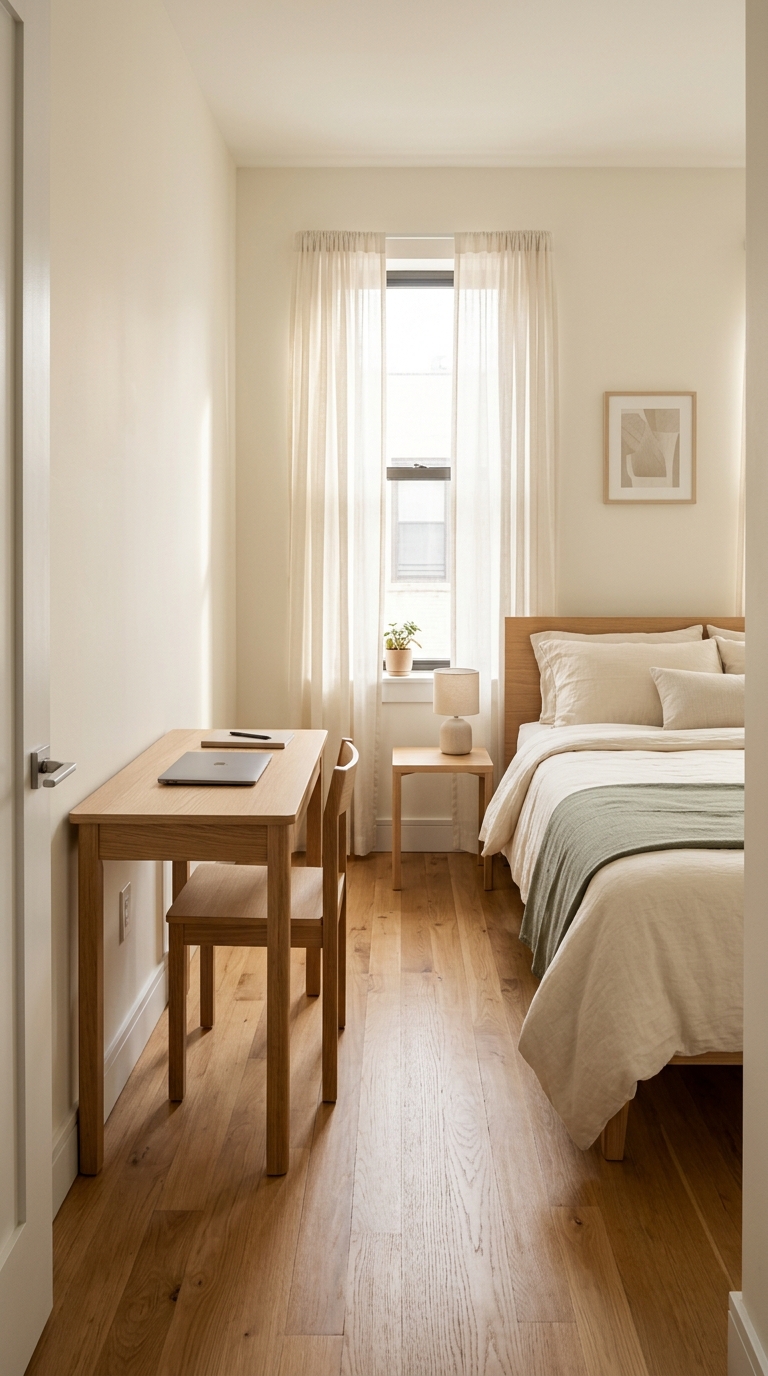
6. Prepare Bedding, Towels, and Nighttime Essentials
A room can look organized but still leave guests feeling awkward if they have to ask where to find a towel or switch on a light in the dark.
Start with clean bedding that suits the season. Check the sheets, pillows, and blankets, and make sure there is an additional layer available if the room gets cold at night.
You do not need decorative pillows that take up half the bed. A comfortable sleeping arrangement is more important than styling the room for a photograph.
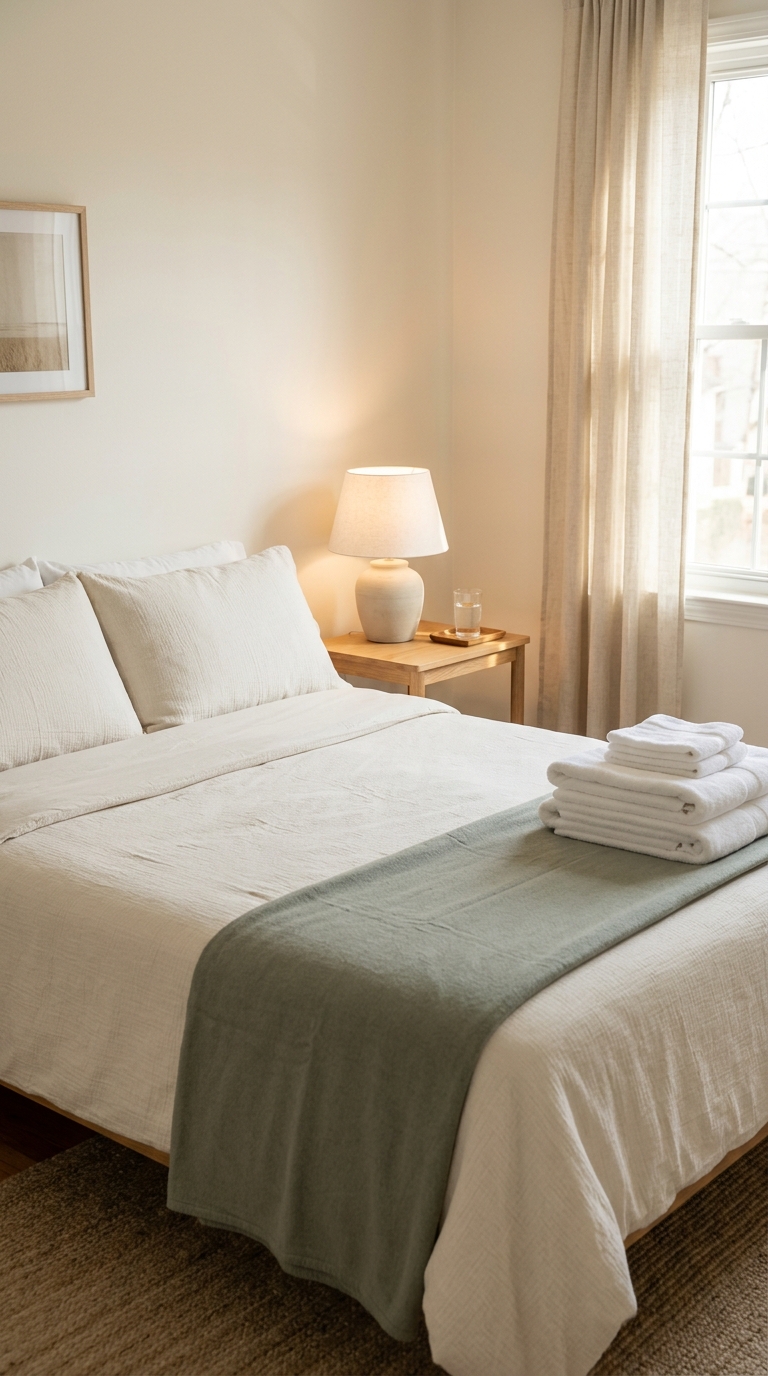
Set aside clean towels somewhere guests can find them easily. You might place them on the bed before arrival or on an accessible shelf. If your household uses shared bathroom storage, explain where guests can find what they need.
Then consider the small things that make a room easier to use:
- Lighting: Provide a working lamp or another suitable light source that can be reached safely.
- Bedside space: Leave a stable surface for glasses, a phone, or a book.
- Charging: Make an accessible outlet available where possible, with cables routed safely away from walking paths.
- Temperature: Explain how to adjust the heating or cooling if guests are unfamiliar with the room.
- Privacy: Check that curtains or blinds work and provide appropriate privacy.
If you do not have a bedside table, look at an existing stable surface that can serve the purpose. Do not introduce a makeshift table that could tip over.
Also, avoid filling the bedside area with items guests may not need. Leave enough room for their own belongings.
These details do not require an expensive makeover. They simply show that you have considered what it is like to spend a night in the room.
7. Add Storage Without Making the Room Feel Smaller
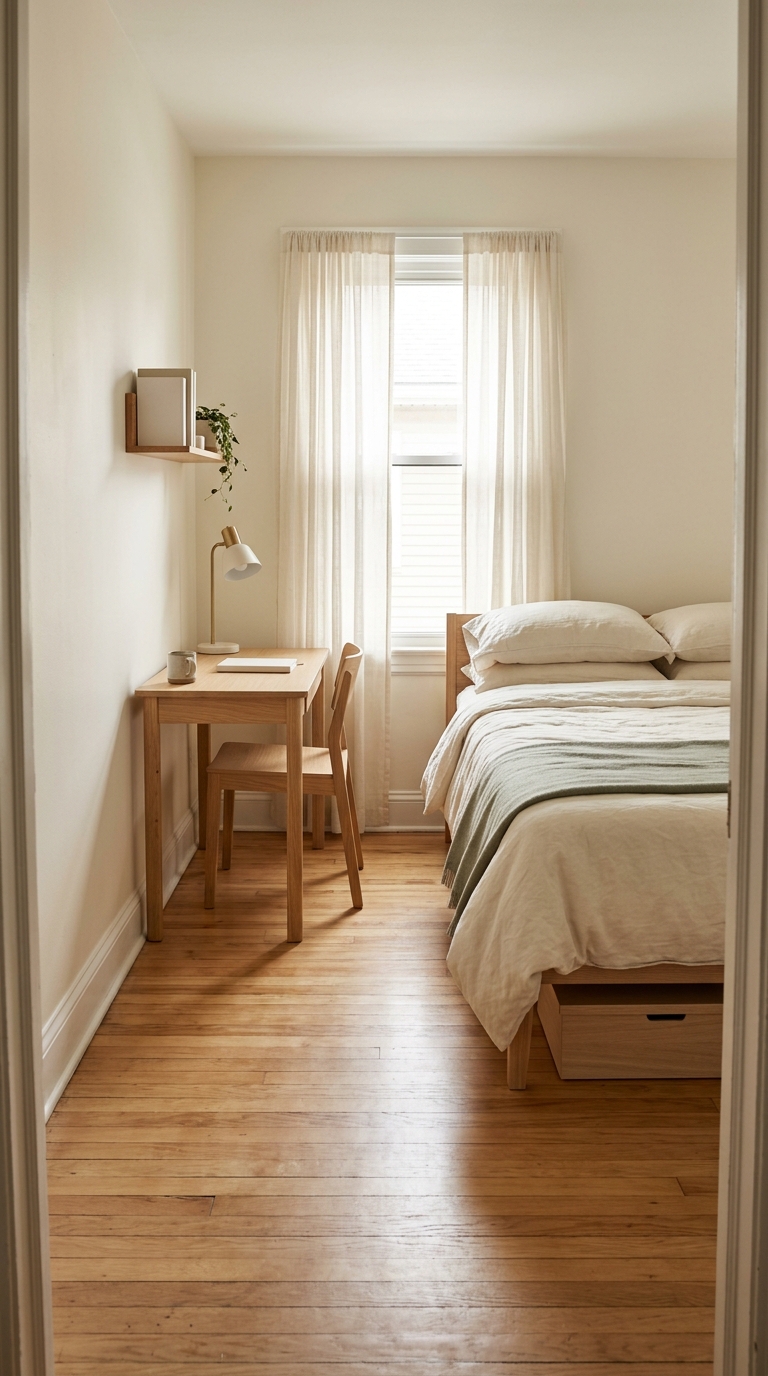
When a room feels crowded, adding another organizer can seem like the obvious solution. But baskets, shelving units, and storage benches still occupy space. Before buying anything, see whether existing drawers, shelves, or under-bed space can solve the problem without making the room harder to use.
Could a drawer hold the spare bedding? Could an existing shelf accommodate folded towels? Could a basket contain the office supplies you need to move temporarily?
Under-bed storage may also work if the bed has enough clearance and the containers fit properly. Use it for items that do not need to be accessed frequently, and avoid cramming belongings underneath if doing so makes them difficult to retrieve.
If you need containers, group similar items together. One box for craft supplies is easier to manage than several small piles scattered around the room.
Be thoughtful about wall storage, too. A properly secured shelf may free up floor space, but it is not worth installing one if it creates a hazard or requires more work than the temporary arrangement justifies.
Here is a useful test before purchasing anything:
- Can something you already own solve the problem?
- Will the new item make the room easier to use, rather than merely give clutter somewhere to hide?
- Where will the item live when the guests leave?
If you cannot answer those questions, wait before buying.
A small guest room does not need to use every inch of available space. Leaving a little room to move is part of making the space functional.
If children may visit during the holidays, make sure shelves and other furniture are stable and appropriately secured. The U.S. Consumer Product Safety Commission explains how to prevent furniture tip-over accidents.
8. Make the Room Comfortable Without Overdecorating
Once the layout and storage are sorted, turn your attention to comfort.
Start with the basics: clean surfaces, fresh bedding, suitable lighting, privacy, and a comfortable temperature. Dust the furniture, empty the wastebasket, and check that the floor is clean.
Then consider whether anything genuinely useful is missing.
Perhaps a folded blanket would help on chilly nights. Maybe the room needs a working lamp, or the window covering needs adjusting to provide more privacy.
You can add a simple decorative touch if you have the space, but do not feel obliged to buy matching cushions, seasonal ornaments, or a new set of accessories.
If the room doubles as an office, let it look like an office that has been thoughtfully prepared for a guest. There is nothing wrong with a desk remaining visible, provided it does not interfere with the sleeping area or make the room difficult to use.
The same applies to a craft room. A neatly contained project or a few supplies on a shelf do not automatically make the room unwelcoming.
Think about what your guest will experience rather than what the room would look like in a staged photograph. Can they sleep comfortably, find their belongings, use the light, and move around without asking you to rearrange everything?
If the answer is yes, you have done the important work.
9. A 15-Minute Reset to Get Your Small Guest Room Ready
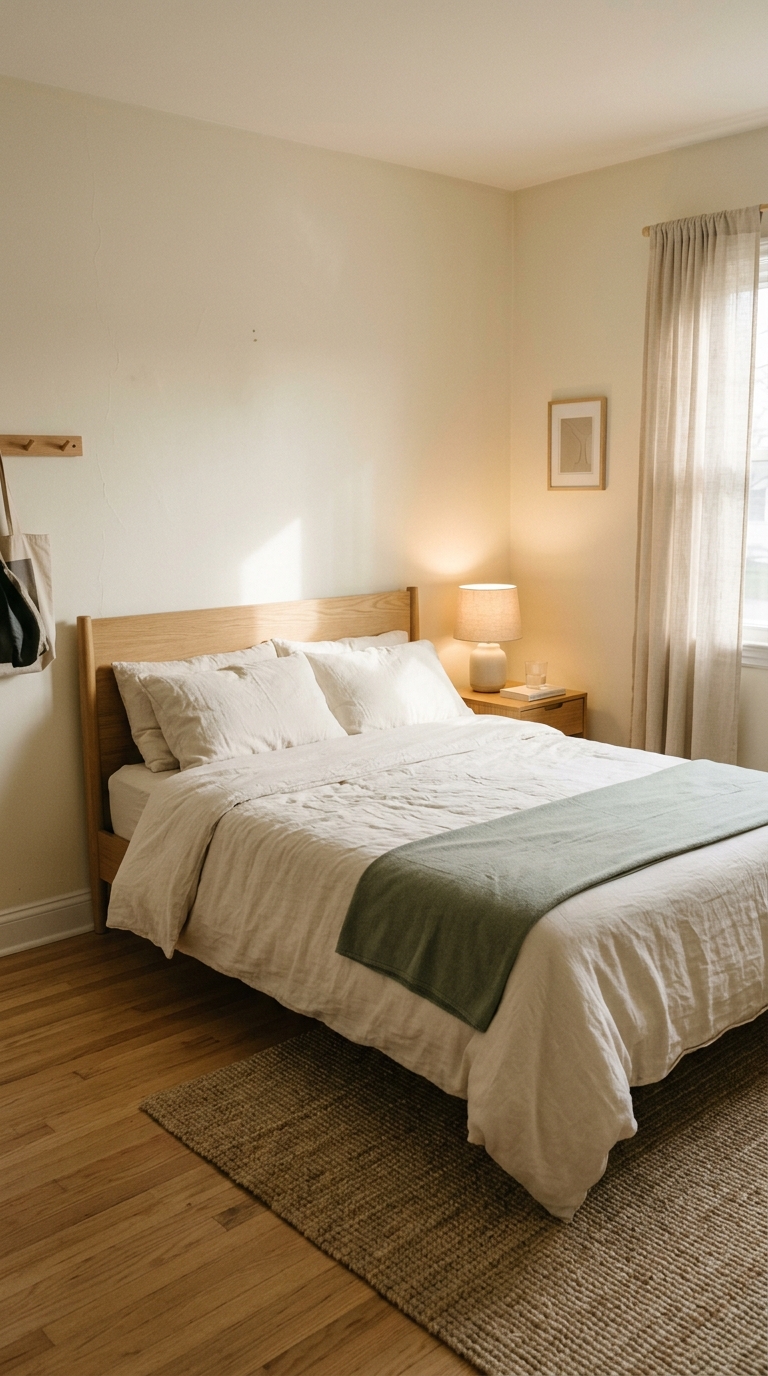
The main organizing work should happen before the day your guests arrive. Your final reset is for checking the room, not trying to reorganize it from scratch.
Once the room is prepared, use this 15-minute checklist.
The 15-Minute Guest Room Reset
A quick final check for a room that has already been prepared. Focus on comfort, clear paths, and the essentials—not perfection.
- Clear and straighten the bedding (fresh sheets, extra blanket ready)
3 min - Tuck away surface clutter (stray mugs, daily papers, loose supplies)
3 min - Confirm luggage and closet space (hangers accessible, landing spot open)
2 min - Set out fresh towels and nighttime essentials (lamp working, outlet accessible)
3 min - Check the walking paths (door opens freely, no loose floor cords)
2 min - Check privacy and comfort (blinds or curtains adjusted, room temperature comfortable)
2 min
A comfortable room matters more than a perfect room.
If the room is still full of boxes or the bed has not been cleared, you need more than a 15-minute reset. Start earlier and tackle the larger decisions first.
And remember to plan for the return to normal. Keep relocated belongings grouped together so you can put them back without having to organize the rest of your home all over again.
For the wider holiday preparation, our guide to getting a small home ready for the holidays without feeling overwhelmed can complement this room-by-room approach.
Frequently Asked Questions
How do you organize a small guest room?
Start by deciding what needs to stay in the room and what can move temporarily. Clear the sleeping area and walking routes, designate space for a suitcase and a few clothes, and prepare clean bedding, towels, lighting, and other essentials. Use existing furniture wherever possible.
How do you turn an office into a guest room for the holidays?
Keep the desk and equipment you still need, but contain loose supplies and put confidential paperwork away securely. Prepare a comfortable sleeping area, create a place for luggage, and agree on a practical work schedule if you will need to use the office while guests are staying.
Where should guests put their suitcases in a small room?
Choose a stable spot against a wall or in an unused corner that does not block the door, closet, or route around the bed. An existing bench or luggage rack may work, but neither is essential. If a large suitcase cannot fit safely, arrange an alternative before the guest arrives.
How much closet space should you leave for guests?
The amount depends on the length of the visit and the storage available. A few hangers and a small section of hanging space may be enough for a short stay. For longer visits, consider clearing a drawer or shelf as well. You do not need to empty the entire closet.
How can you make a small guest room comfortable without buying new furniture?
Focus on clean bedding, towels, suitable lighting, privacy, a clear walking route, and a designated place for personal belongings. Repurpose a drawer, shelf, or stable existing surface rather than purchasing furniture simply because a guest is coming.
A Comfortable Guest Room Does Not Need to Be Perfect
Preparing a small guest room for the holidays is not about hiding every sign of everyday life. It is about making room for another person without making your own home harder to live in.
Keep what you need, contain what can wait, and make the sleeping area comfortable and safe. When the visit is over, return the temporarily relocated items to their proper homes.
You do not need a perfect spare bedroom to be a thoughtful host. You need a room that works for the people who live in your home and the people you welcome into it.