15 New Year’s Bible Crafts for Kids to Welcome the Year With Faith
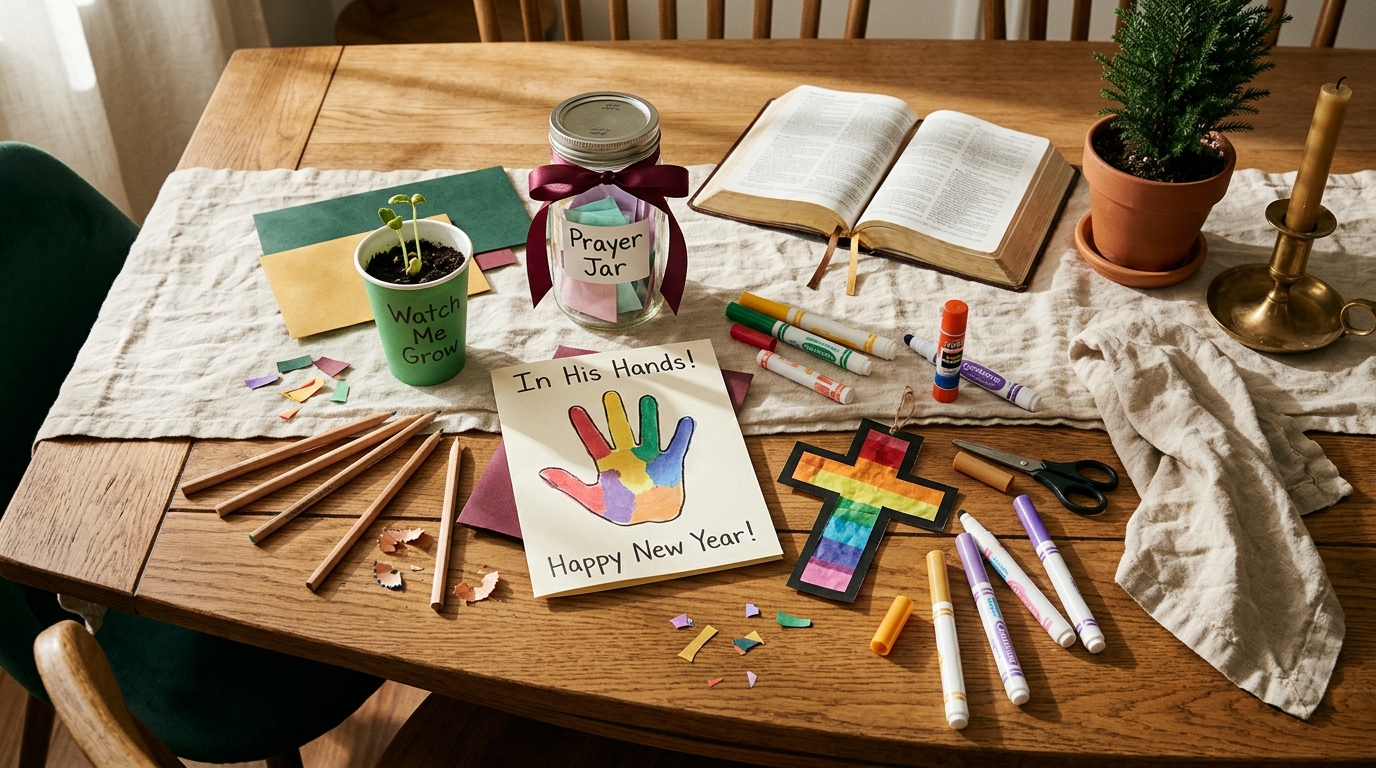
New Year’s Bible crafts for kids offer families a simple way to talk about fresh beginnings, gratitude, kindness, and trusting God. Instead of making the celebration all about countdowns and resolutions, you can use creative activities to help children explore what the Bible teaches about living with faith.
These projects combine familiar supplies with meaningful Scripture lessons. Some help children think about prayer and gratitude, while others introduce biblical stories, encourage kindness, or make it easier to remember God’s Word throughout the year.
You don’t need expensive craft kits or complicated instructions. Most of these projects use paper, jars, cardboard, crayons, and other supplies you may already have at home. They’re suitable for family craft time, homeschooling, children’s ministry, or Sunday school, with a little adaptation for younger children.
The Bible doesn’t prescribe a special Christian New Year’s craft or celebration. These projects simply use the start of a new calendar year as an opportunity to reflect on Scripture, build good habits, and encourage children to grow in faith.
As you plan each activity, you can look up the Bible passages in your preferred translation using Bible Gateway.
Quick Guide: 15 Bible Crafts for Kids
If you’re short on time, this table makes it easier to find a project that fits your child’s age and your available craft time.
| Craft | Suggested Age | Approximate Time |
|---|---|---|
| My Year in God’s Hands Handprint | 3+ | 20 minutes |
| New Year Prayer Jar | 3+ | 20–30 minutes |
| Bible Verse Memory Match Game | 5+ | 25–35 minutes |
| Gratitude Paper Quilt | 4+ | 25–40 minutes |
| Grow in Faith Seed Cup | 3+ | 15–20 minutes |
| Family Blessing Placemat | 4+ | 25–35 minutes |
| Little Acts of Service Coupon Book | 4+ | 20–30 minutes |
| 12-Month Bible Verse Memory Ring | 6+ | 30–40 minutes |
| Praise and Worship Ribbon Wand | 4+ | 15–20 minutes |
| Good Samaritan Shoebox Scene | 5+ | 30–45 minutes |
| Scripture Encouragement Postcards | 4+ | 20–30 minutes |
| Fruit of the Spirit Paper Bracelet | 4+ | 20–25 minutes |
| Rainbow Promise Suncatcher | 4+ | 25–35 minutes |
| Armor of God Paper Shield | 5+ | 25–35 minutes |
| Kindness Character Crown | 4+ | 20–25 minutes |
Times are estimates and may vary with the child’s age, preparation, and group size. The seed cup’s time covers making the craft, not the ongoing care needed for the plant to grow. Younger children will need adult assistance with some steps.
15 New Year’s Bible Crafts for Kids
1. My Year in God’s Hands Handprint
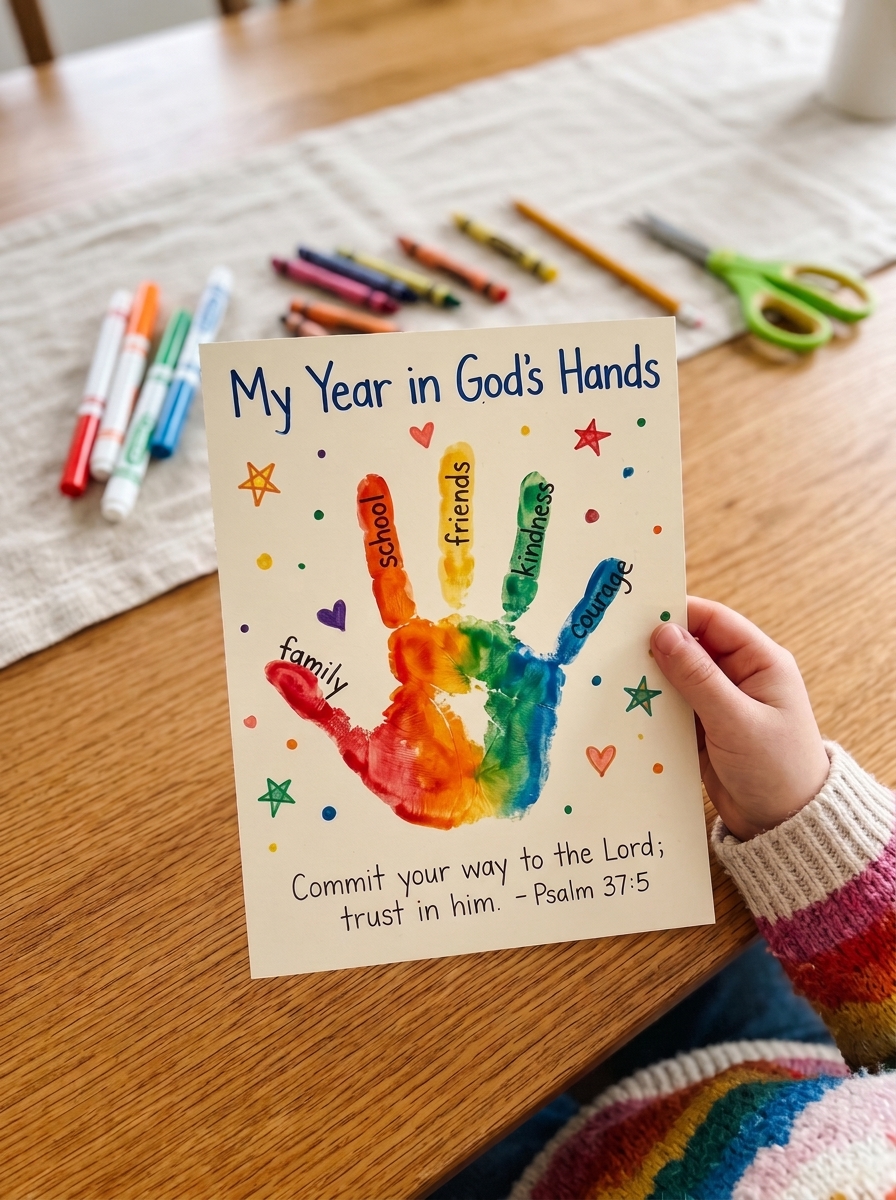
Bible passage: Psalm 37:5
The lesson: Trusting God with our plans.
This craft gives children a simple visual reminder that they can bring their hopes, plans, and worries to God. Psalm 37:5 encourages believers to commit their way to the Lord and trust in Him. It isn’t a promise that every plan will happen exactly as we imagine; it teaches us to place our lives in God’s care.
Materials:
- White or light-colored cardstock
- Washable paint or crayons
- Pencil
- Markers
- Optional stickers and decorative paper
How to make it:
- Help your child trace one hand on a sheet of cardstock.
- Cut out the hand shape, or leave it on the page and decorate around it.
- Write the words “My Year in God’s Hands” across the top.
- On each finger, write or draw something your child wants to pray about this year. Ideas might include school, family, friendships, courage, or learning something new.
- Add Psalm 37:5 beneath the handprint.
- Let your child decorate the background with stars, hearts, or simple patterns.
Talk about it: Ask your child what it means to trust God with something they cannot control. Explain that they can pray about their plans while remembering that God may guide them in a different direction.
Age and time: Ages 3 and up with help; approximately 20 minutes.
2. New Year Prayer Jar
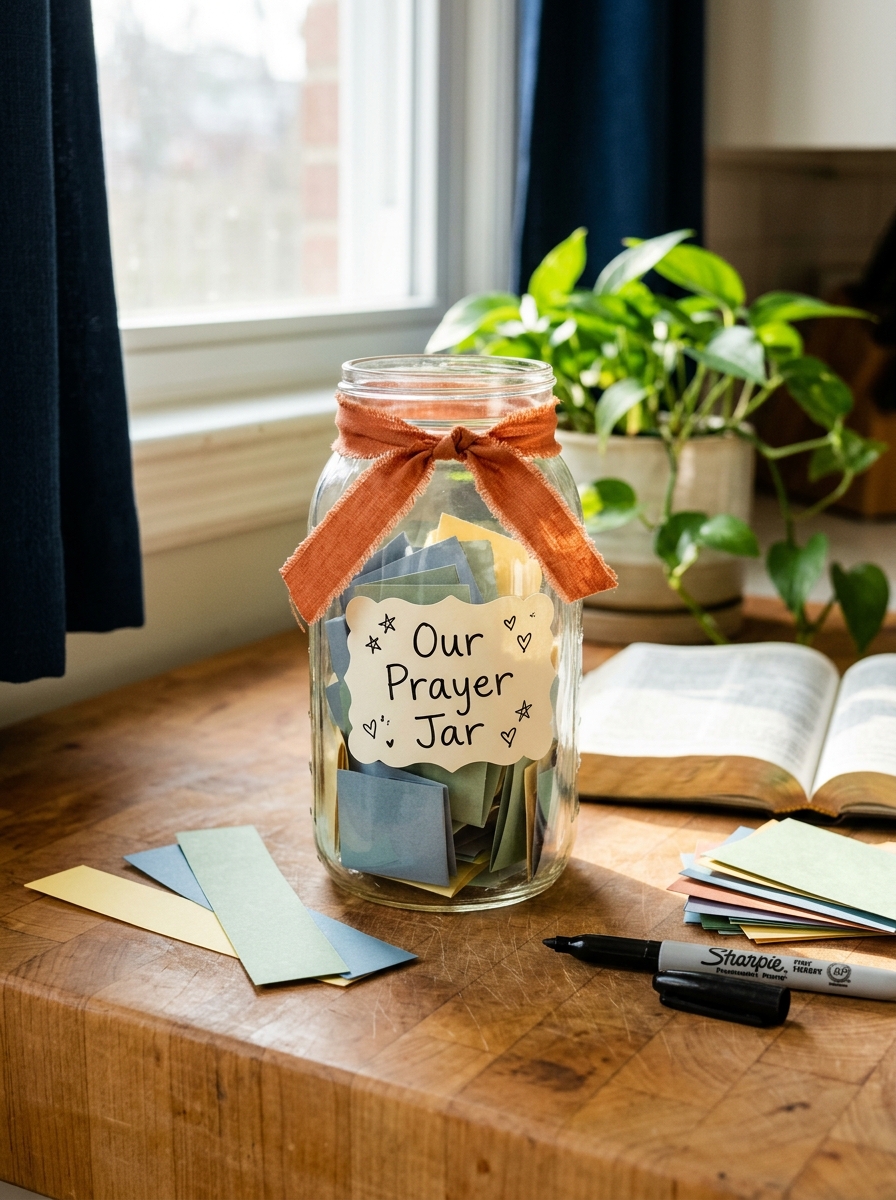
Bible passage: Philippians 4:6–7
The lesson: Bringing worries and requests to God through prayer.
A prayer jar gives children a place to collect things they want to talk to God about. It can become a simple family habit throughout the year, rather than a craft that gets forgotten after January.
Philippians 4:6–7 encourages believers to bring their requests to God with prayer and thanksgiving. The passage points to God’s peace, even when life feels difficult.
Materials:
- Clean, empty jar or plastic container
- Colored paper
- Markers
- Glue or decorative tape
- Ribbon or stickers
- Small pieces of paper for prayer notes
How to make it:
- Clean and dry the jar or container.
- Cut a paper label and write “Our Prayer Jar” on it.
- Decorate the outside with simple shapes, stars, or Bible-themed stickers.
- Cut several small pieces of paper for prayer notes.
- Invite each child to write or draw something they would like to pray about.
- Fold the notes and place them inside the jar.
- Choose a regular time, such as Sunday evening, to select a note and pray together.
For children who cannot write yet, an adult can write down their words or help them draw a picture.
Talk about it: Explain that prayer isn’t only for asking for things. Children can also thank God, ask for help, and pray for other people.
Age and time: Ages 3 and up with adult assistance; 20–30 minutes.
3. Bible Verse Memory Match Game
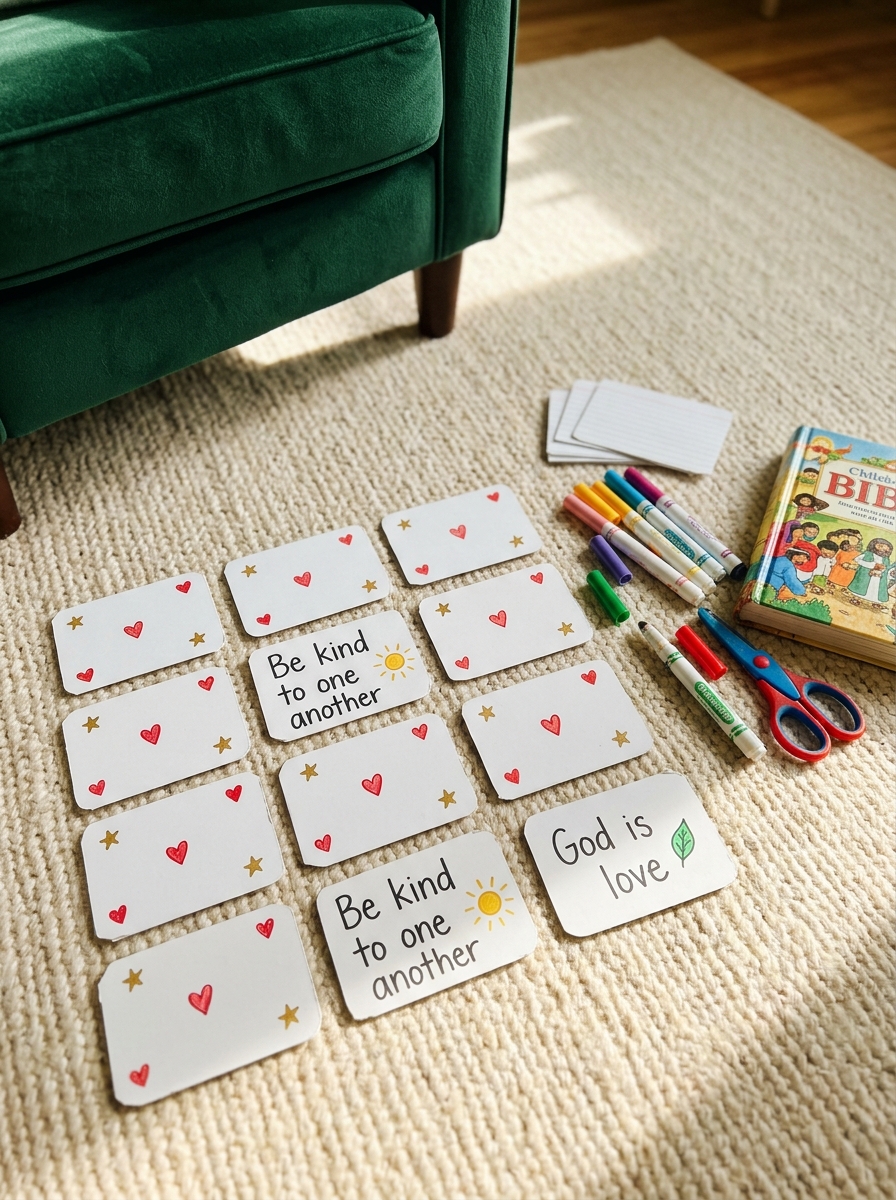
Bible passage: Psalm 119:11
The lesson: Keeping God’s Word in our hearts.
Children can turn Scripture learning into a game with homemade matching cards. Psalm 119:11 describes storing God’s Word in the heart as a way of resisting sin and living faithfully.
This activity works particularly well for families or Sunday school groups because children can play together after making their cards.
Materials:
- Cardstock or index cards
- Markers
- Scissors
- Crayons or stickers
- A few short Bible verses or Scripture phrases
How to make it:
- Cut the cardstock into equal-sized cards.
- Choose three to five short Bible verses or phrases suitable for your children’s ages.
- Write each verse or phrase on two separate cards, making a matching pair.
- Add a small picture or symbol to each pair to help younger children recognize them.
- Turn all the cards face down on a table.
- Take turns turning over two cards at a time to find matching verses.
- When a pair is found, read the verse aloud and briefly discuss what it means.
For younger children, use pictures and short phrases instead of asking them to memorize long passages.
Encourage children to explain the verse in their own words before moving on to the next pair. This helps them understand the message instead of simply remembering matching cards.
Talk about it: Ask why remembering God’s Word can help us make wise and loving choices.
Age and time: Ages 5 and up; approximately 25–35 minutes.
4. Gratitude Paper Quilt
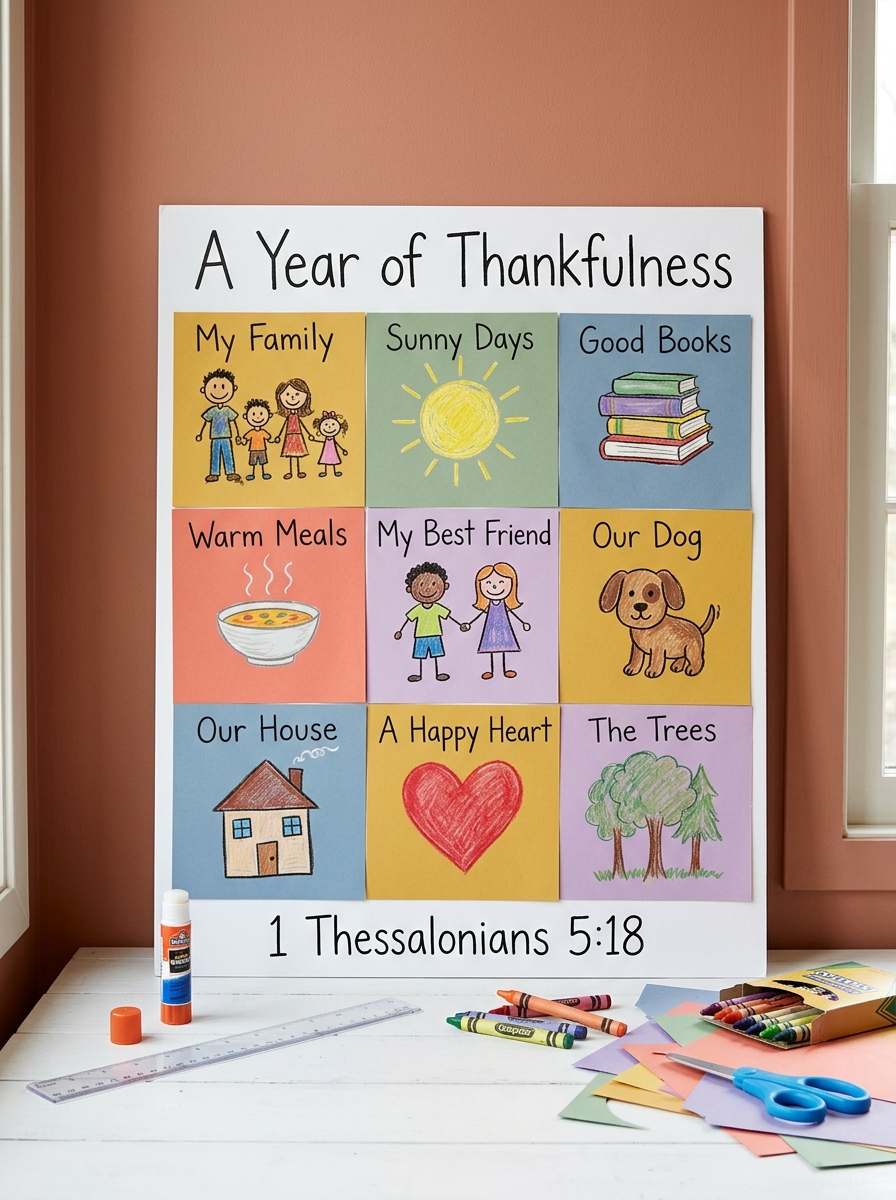
Bible passage: 1 Thessalonians 5:18
The lesson: Practicing thankfulness.
A paper quilt is a colorful way for children to look back on the good things in their lives. It also creates an opportunity to discuss gratitude without suggesting that children must pretend everything is perfect.
First Thessalonians 5:18 encourages believers to give thanks in all circumstances. This doesn’t mean being thankful for painful things or ignoring difficulties. It means learning to recognize and appreciate God’s goodness even when life isn’t easy.
Materials:
- Several sheets of colored construction paper
- White cardstock or poster board
- Markers and crayons
- Glue stick
- Scissors
- Ruler
How to make it:
- Cut colored paper into equal-sized squares.
- Give each child several squares to decorate.
- On each square, ask them to draw or write something they are thankful for, such as a friend, a meal, a favorite book, or time with family.
- Arrange the squares together on a larger sheet of cardstock.
- Glue them in rows to create a quilt pattern.
- Write “A Year of Thankfulness” at the top and add 1 Thessalonians 5:18 at the bottom.
For a group activity, each child can contribute one or two squares to a shared classroom quilt.
Talk about it: Ask children to name something small they appreciate that they might normally overlook.
Age and time: Ages 4 and up; approximately 25–40 minutes.
5. Grow in Faith Seed Cup
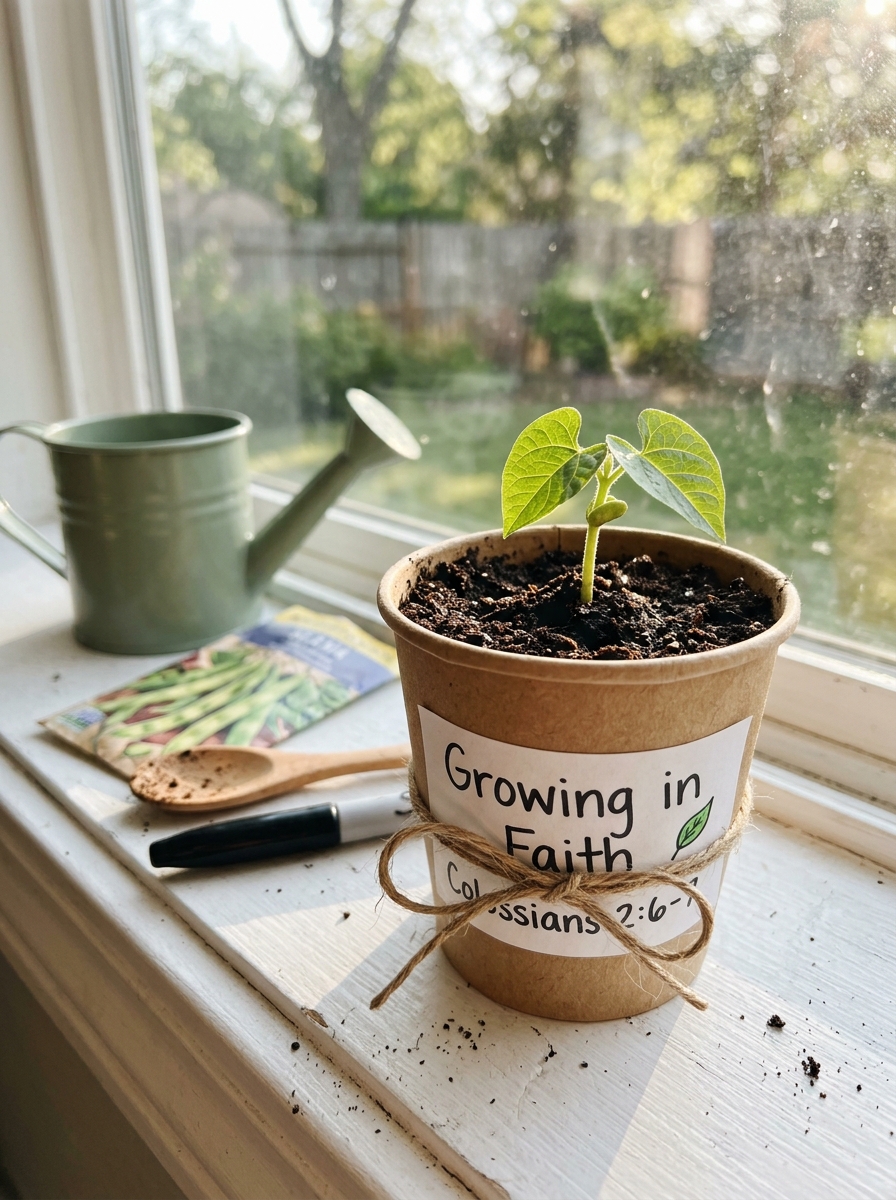
Bible passage: Colossians 2:6–7
The lesson: Growing stronger and more rooted in faith.
Children can plant a real seed and use it to talk about spiritual growth. The growing plant provides a visible reminder that healthy growth takes time, care, and patience.
Colossians 2:6–7 encourages believers to continue living in Christ, rooted and built up in Him. The passage uses the image of roots and growth to describe a life grounded in faith.
Materials:
- Small paper cup or reusable planting pot
- Potting soil
- Fast-growing seeds, such as beans
- Spoon
- Water
- Paper label and markers
How to make it:
- Fill the cup about three-quarters full with potting soil.
- Follow the seed packet instructions to plant one or two seeds at the recommended depth.
- Water gently.
- Make a small label that says “Growing in Faith” and add Colossians 2:6–7.
- Place the cup somewhere with suitable light for the chosen plant.
- Help your child water and observe it as it grows.
Explain that caring for a seedling requires regular attention. In a similar way, growing in faith involves learning Scripture, praying, worshipping, and practicing what Jesus teaches.
Talk about it: Ask what helps a plant grow and what helps a person grow in faith.
Age and time: Ages 3 and up with adult supervision; 15–20 minutes to make, plus ongoing care.
6. Family Blessing Placemat
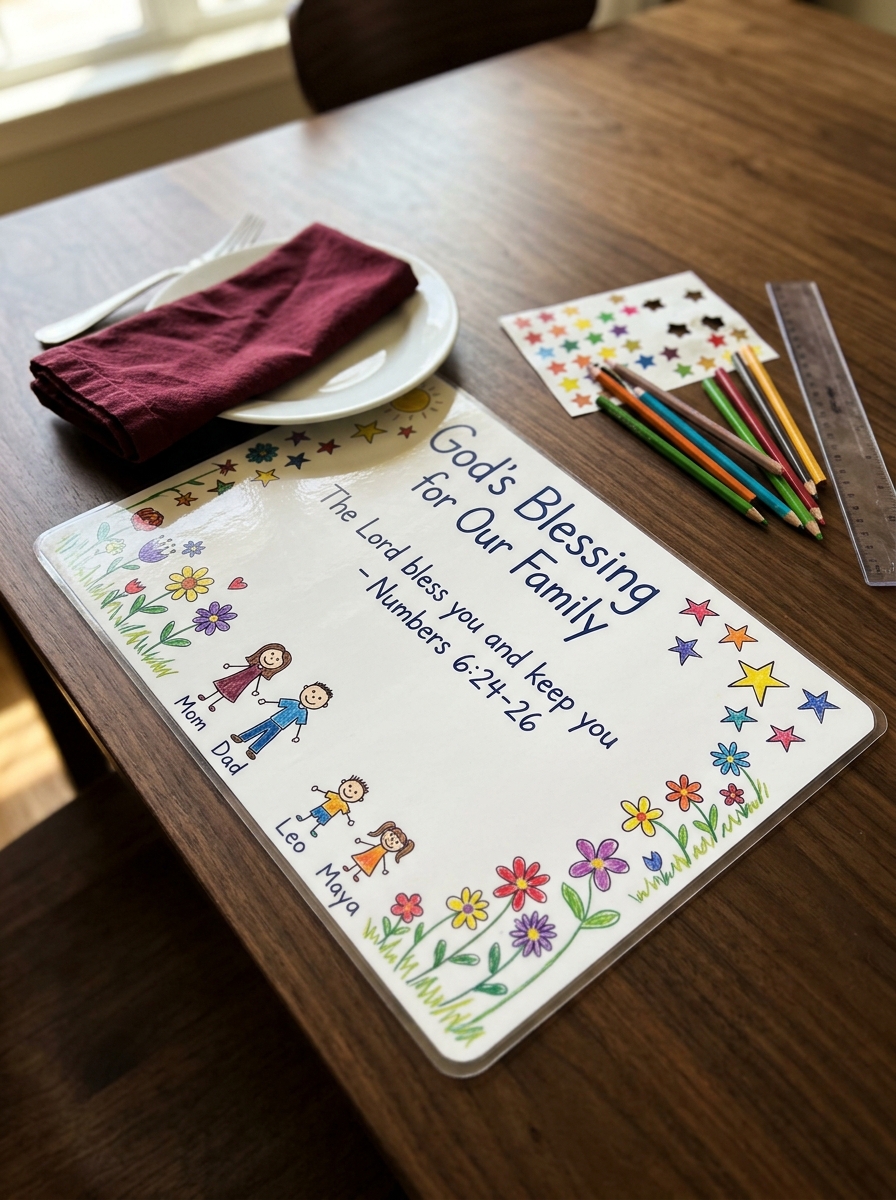
Bible passage: Numbers 6:24–26
The lesson: Understanding blessing, grace, and peace.
Children can make a placemat featuring the blessing recorded in Numbers 6:24–26. In this passage, God gives Moses instructions for Aaron and his sons to bless the Israelites. The words speak of God’s care, grace, and peace.
This is a lovely craft for families because children can see the finished project during everyday meals.
Materials:
- A sheet of cardstock or thick paper
- Colored pencils or markers
- Stickers
- Ruler
- Clear contact paper or a laminating pouch, if available
How to make it:
- Cut cardstock to a suitable placemat size.
- Write “God’s Blessing for Our Family” across the top.
- Add Numbers 6:24–26, using a short excerpt or a reference to the passage.
- Invite your child to decorate the edges with flowers, stars, or family-themed drawings.
- Add each family member’s name or a small drawing representing them.
- Cover the finished placemat with clear contact paper or laminate it if you want to protect it from spills.
Use the full passage in your preferred Bible translation when discussing the craft. The wording differs slightly between translations.
Talk about it: Discuss what it means to wish someone peace and to ask God to care for them.
Age and time: Ages 4 and up; approximately 25–35 minutes.
7. Little Acts of Service Coupon Book
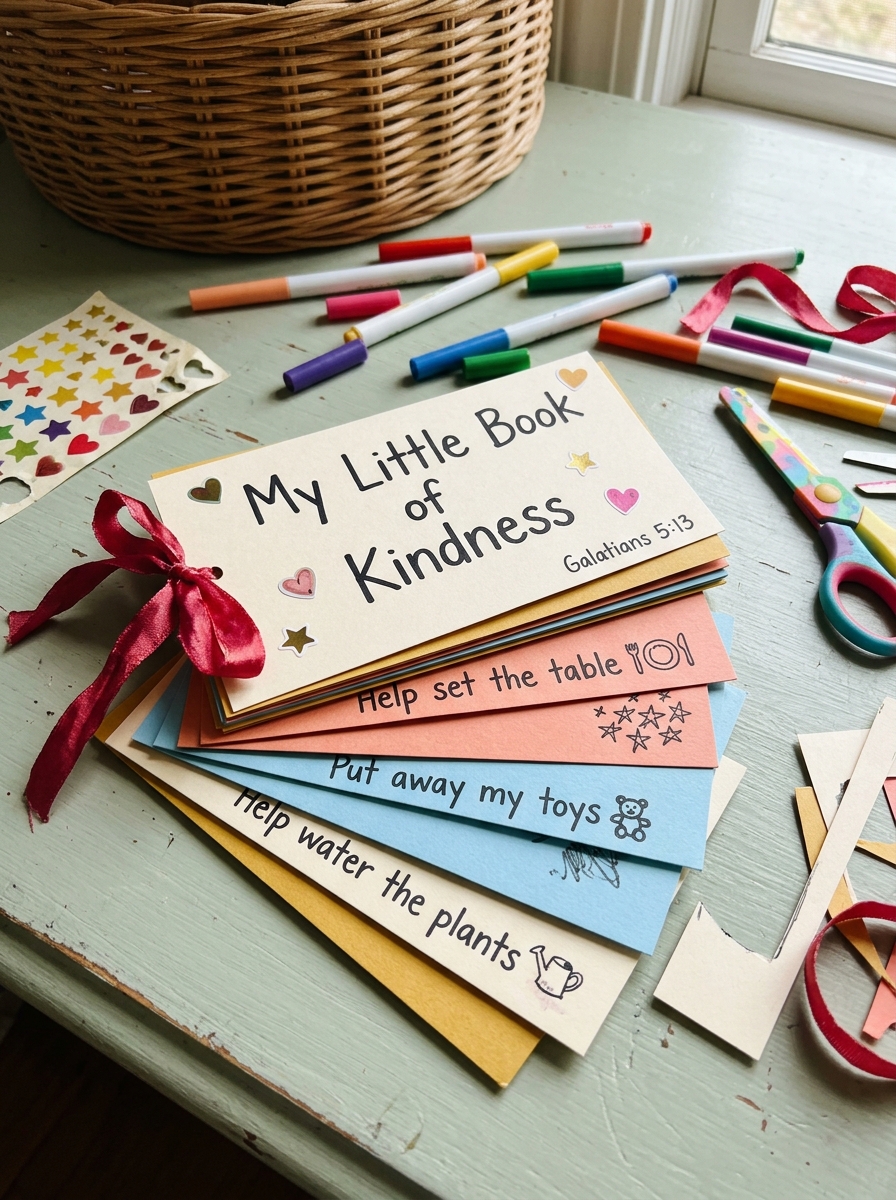
Bible passage: Galatians 5:13
The lesson: Using love to serve others.
A coupon book can help children think about practical ways to show love at home. Instead of making big New Year’s resolutions, they can choose small, realistic acts of service.
Galatians 5:13 teaches believers to serve one another humbly in love. The point isn’t to earn God’s approval through good deeds. It’s to show love through the way we treat people.
Materials:
- Colored paper or cardstock
- Scissors
- Markers
- Stapler or ribbon
- Stickers
How to make it:
- Cut several small rectangles of cardstock.
- Write one helpful action on each card, such as “Help set the table,” “Put away my toys,” or “Help water the plants.”
- Let your child decorate each coupon.
- Add a cover that says “My Little Book of Kindness.”
- Stack the cards and staple one edge or tie them together with ribbon.
- Encourage your child to choose one coupon to use when someone at home needs help.
Make sure the tasks are suitable for the child’s age and abilities. Avoid turning the book into a reward system in which children expect payment for every act of kindness.
Talk about it: Ask how helping someone can make their day easier.
Age and time: Ages 4 and up; approximately 20–30 minutes.
8. 12-Month Bible Verse Memory Ring
Bible passage: Deuteronomy 6:6–7
The lesson: Making God’s Word part of everyday life.
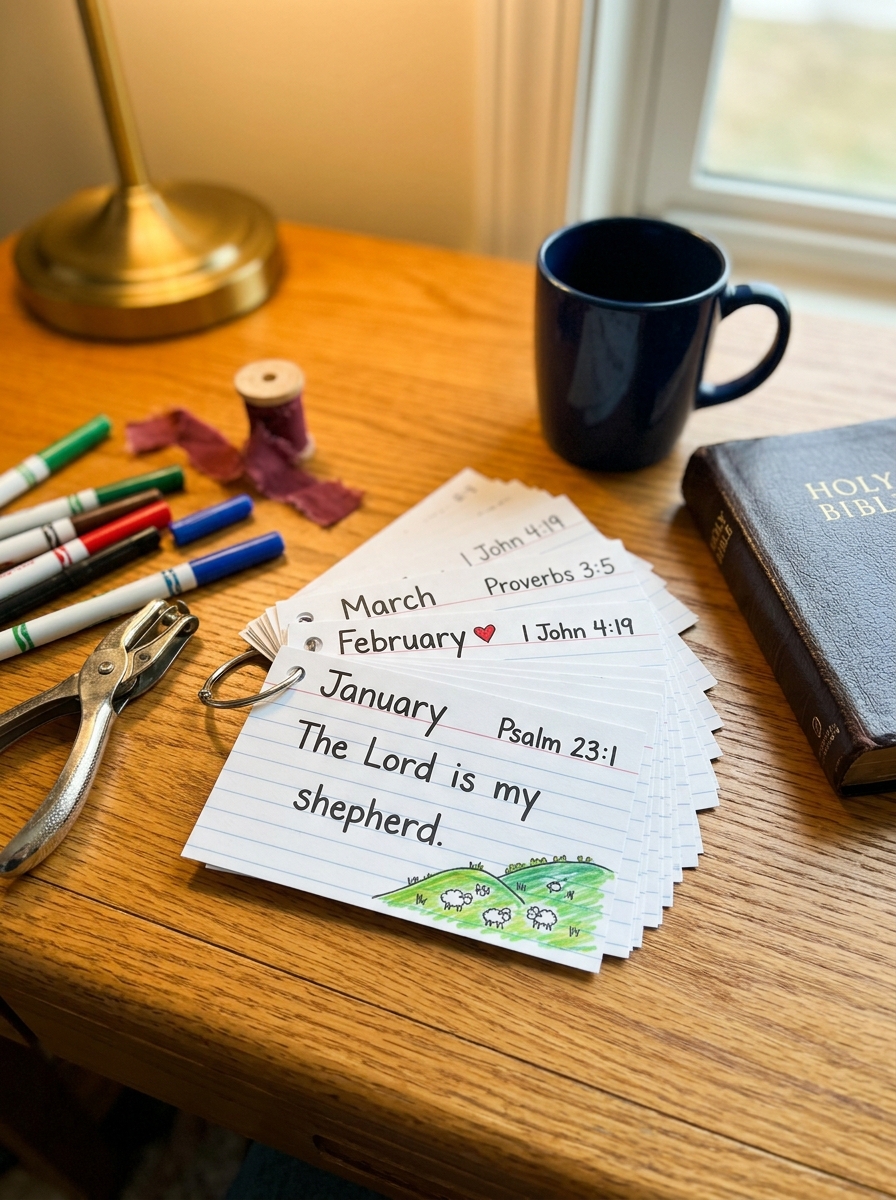
This craft turns Scripture learning into a simple activity that can continue beyond the New Year celebration. Children create a ring of twelve cards, with one Bible verse or short Scripture phrase for each month.
Deuteronomy 6:6–7 instructs God’s people to keep His commandments in their hearts and teach them diligently to their children. The passage emphasizes that faith should be part of ordinary family life.
Materials:
- Twelve index cards or cardstock rectangles
- Hole punch
- Binder ring or ribbon
- Markers
- Bible
How to make it:
- Cut twelve equal-sized cards.
- Choose twelve short Bible verses or passages that are suitable for your family or class.
- Write one verse reference on each card, adding a short phrase or child-friendly explanation.
- Invite children to decorate the cards with small drawings.
- Punch a hole in the same corner of every card.
- Attach the cards to a binder ring or tie them together with ribbon.
- At the beginning of each month, choose one card to read and discuss.
Choose verses that are understandable for the children’s ages. An adult can write out the full verse on the reverse side if needed.
Talk about it: Ask how reading and discussing one Bible verse regularly might help a family remember God’s teachings.
Age and time: Ages 6 and up, with adult help for younger children; approximately 30–40 minutes.
9. Praise and Worship Ribbon Wand
Bible passage: Psalm 150:4–6
The lesson: Praising God with joy.
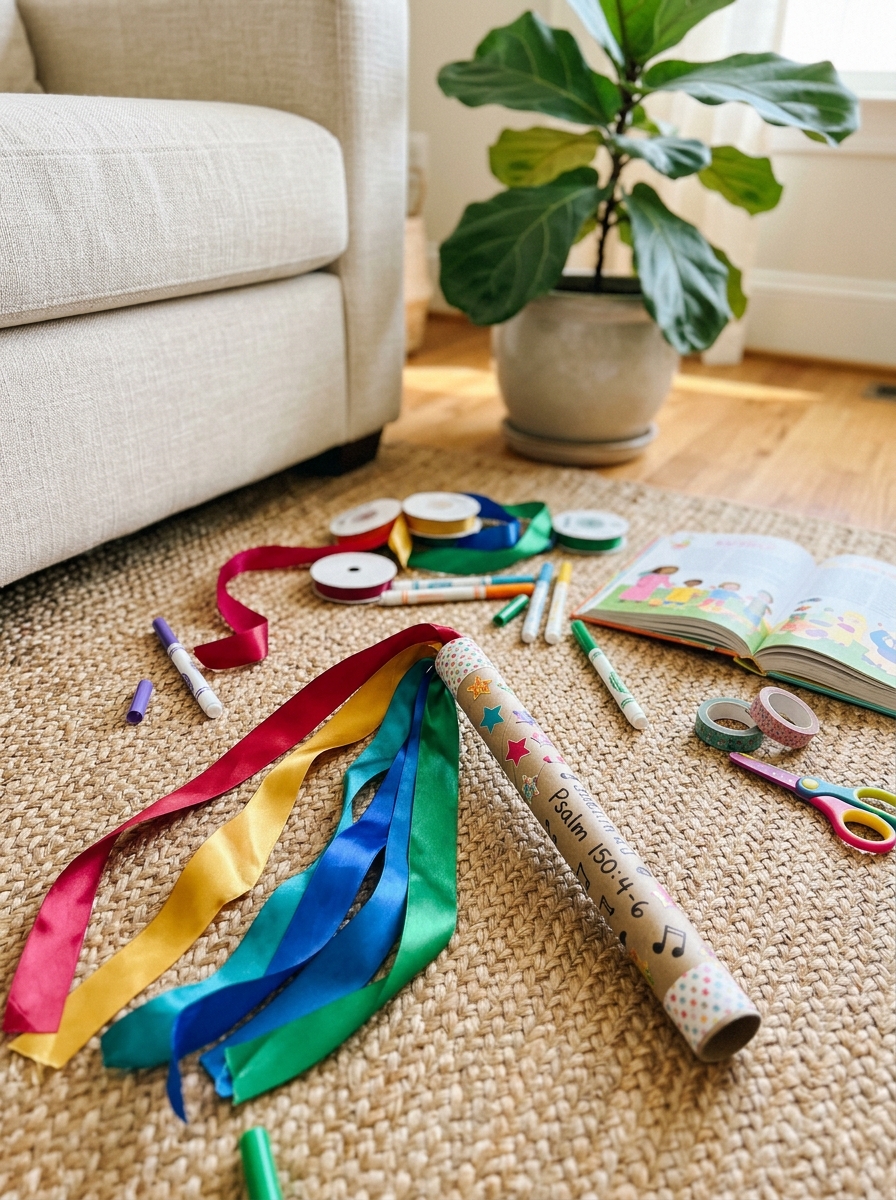
Psalm 150 calls on everything that has breath to praise the Lord and mentions several instruments used in worship. A ribbon wand gives children a creative way to respond to the passage through movement and music.
Materials:
- Wide craft ribbon
- A cardboard tube or sturdy paper handle
- Glue or strong tape
- Scissors
- Markers and stickers
How to make it:
- Cut several lengths of ribbon, making sure they are not so long that children trip over them.
- Decorate a cardboard tube with paper, markers, or stickers.
- Attach the ribbon securely to one end of the tube using strong tape or adult-applied glue.
- Allow the adhesive to dry fully.
- Read Psalm 150:4–6 together.
- Play a favorite worship song and let children move their ribbons gently to the rhythm.
For younger children, an adult should prepare the handle and attach the ribbon. Avoid small detachable decorations and supervise the activity.
Talk about it: Ask what praising God can look and sound like. Explain that worship is about honoring God, not simply performing or making noise.
Age and time: Ages 4 and up with supervision; approximately 15–20 minutes.
10. Good Samaritan Shoebox Scene
Bible passage: Luke 10:25–37
The lesson: Showing compassion to people who need help.
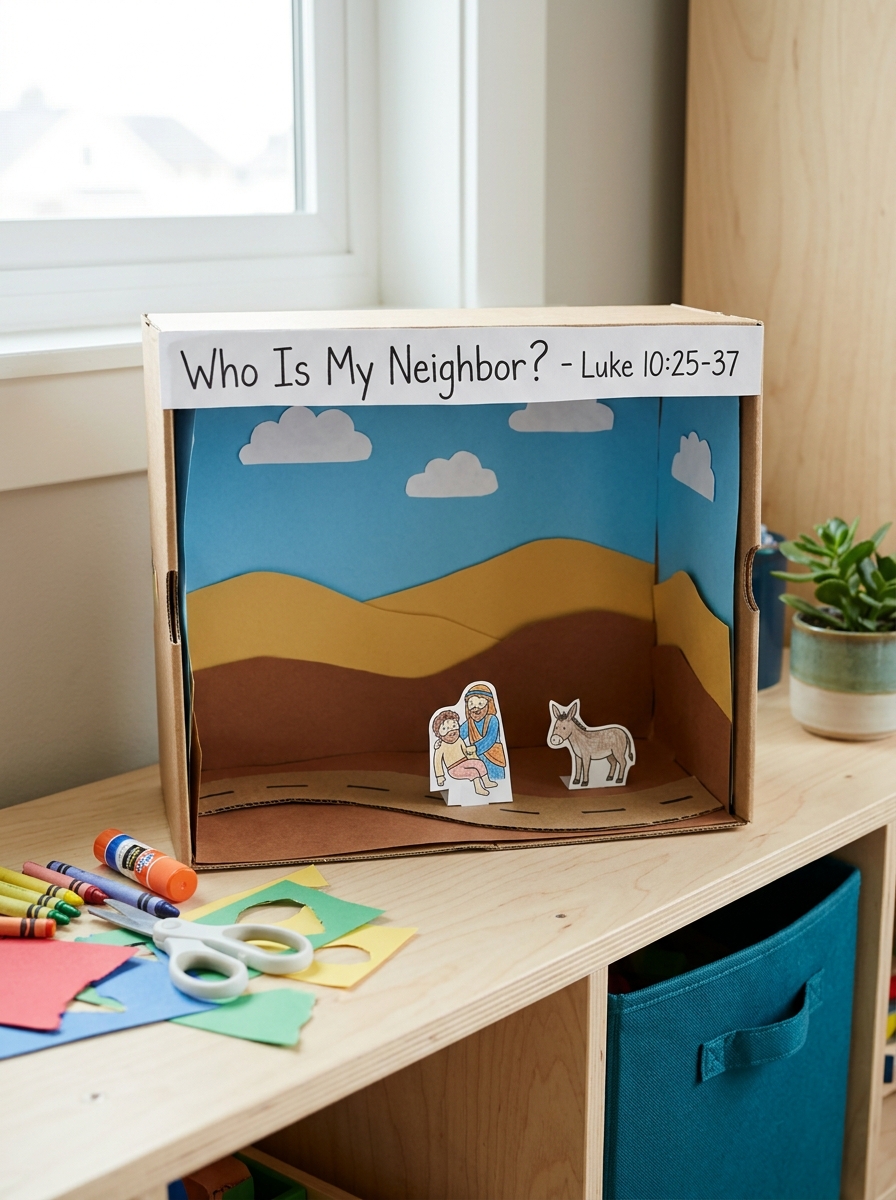
This miniature Bible scene helps children remember the story Jesus told about the Good Samaritan. In the story, a man is attacked and left on the road. Several people pass him, but a Samaritan stops to care for him. Jesus uses the story to teach what it means to be a neighbor.
Materials:
- Empty shoebox
- Construction paper
- Cardboard scraps
- Crayons or markers
- Child-safe scissors
- Glue stick
- Small paper figures
How to make it:
- Turn the shoebox on its side so the open side faces forward.
- Cover the inside with paper to create a simple road and landscape.
- Cut out paper figures representing the injured traveler, the Samaritan, and the other travelers.
- Add small cardboard shapes to represent the road, rocks, or nearby buildings.
- Position the figures inside the box.
- Write “Who Is My Neighbor?” on the outside and add the reference Luke 10:25–37.
- Retell the story together, using the figures to show what happened.
You can prepare the paper figures ahead of time for younger children.
Talk about it: Ask what the Samaritan did differently and how children can show kindness to someone who feels left out or needs help.
Age and time: Ages 5 and up; approximately 30–45 minutes.
11. Scripture Encouragement Postcards
Bible passage: 1 Thessalonians 5:11
The lesson: Building others up with encouraging words.
Children can create postcards for family members, friends, teachers, or people in their church community. This is a practical way to connect Bible learning with how they communicate with others.
First Thessalonians 5:11 encourages believers to encourage one another and build each other up. The craft gives children a chance to put that instruction into practice.
Materials:
- Cardstock
- Markers or colored pencils
- Stickers
- Ruler
- Scissors
- Envelopes, if available
How to make it:
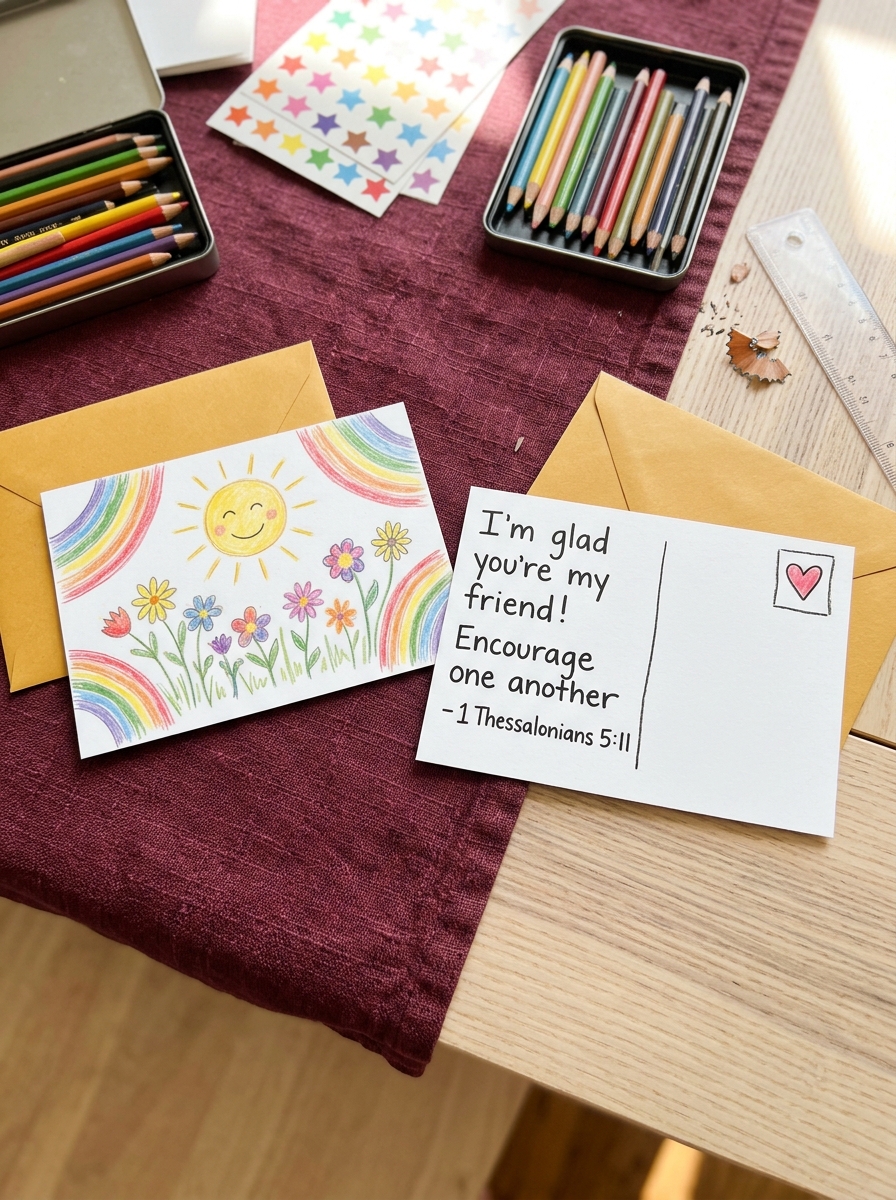
- Cut cardstock into postcard-sized rectangles.
- Decorate the front with a cheerful drawing, such as flowers, sunshine, or a colorful pattern.
- Write a short encouraging message on the reverse side.
- Add a Bible verse reference, such as 1 Thessalonians 5:11.
- Help your child choose someone who might appreciate the message.
- Deliver the postcard or place it in an envelope to send.
Encourage children to write sincere messages rather than simply copying phrases. Examples include “I’m glad you’re my friend” or “Thank you for helping me.”
Talk about it: Ask how kind words can make someone feel and why encouragement matters.
Age and time: Ages 4 and up with writing assistance; approximately 20–30 minutes.
12. Fruit of the Spirit Paper Bracelet
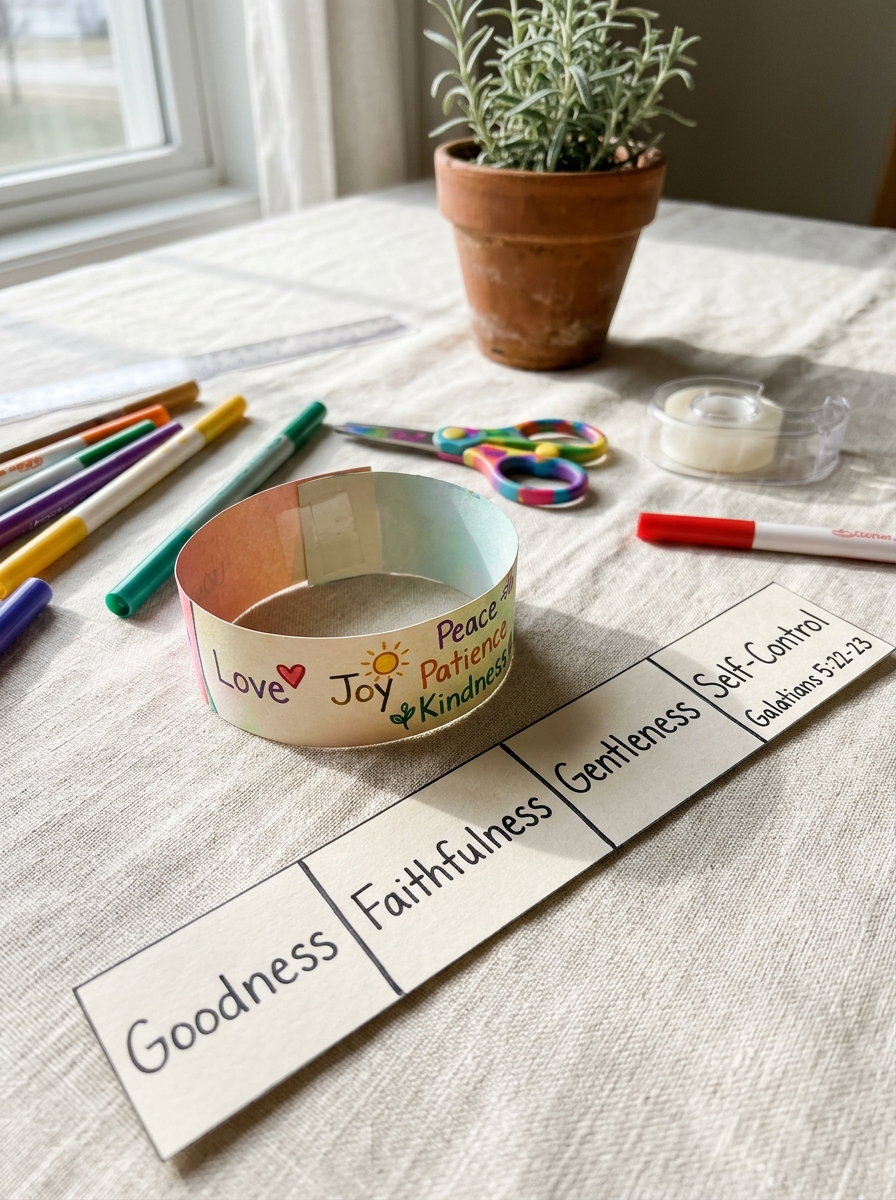
Bible passage: Galatians 5:22–23
The lesson: Growing in godly character.
This bracelet introduces children to the qualities Paul calls the fruit of the Spirit: love, joy, peace, patience, kindness, goodness, faithfulness, gentleness, and self-control.
In Galatians 5, Paul contrasts life guided by the Spirit with behaviors that harm relationships and communities. The fruit of the Spirit describes qualities that grow in a person’s life through the work of the Holy Spirit.
Materials:
- Colored cardstock or construction paper
- Markers
- Ruler
- Scissors
- Tape or glue
- Optional large paper shapes for decoration
How to make it:
- Cut a strip of paper wide enough to fit comfortably around your child’s wrist.
- Divide the strip into nine sections.
- Write one fruit of the Spirit in each section.
- Let your child decorate each section with a small picture or pattern.
- Wrap the strip loosely around the wrist and secure it with tape or glue.
- Read Galatians 5:22–23 together and discuss one quality children can practice during the week.
For preschoolers, make a shorter bracelet with three or four words and explain the remaining qualities through pictures or conversation.
Talk about it: Ask which quality your child finds easiest to show and which one they would like God’s help to develop.
Age and time: Ages 4 and up; approximately 20–25 minutes.
13. Rainbow Promise Suncatcher
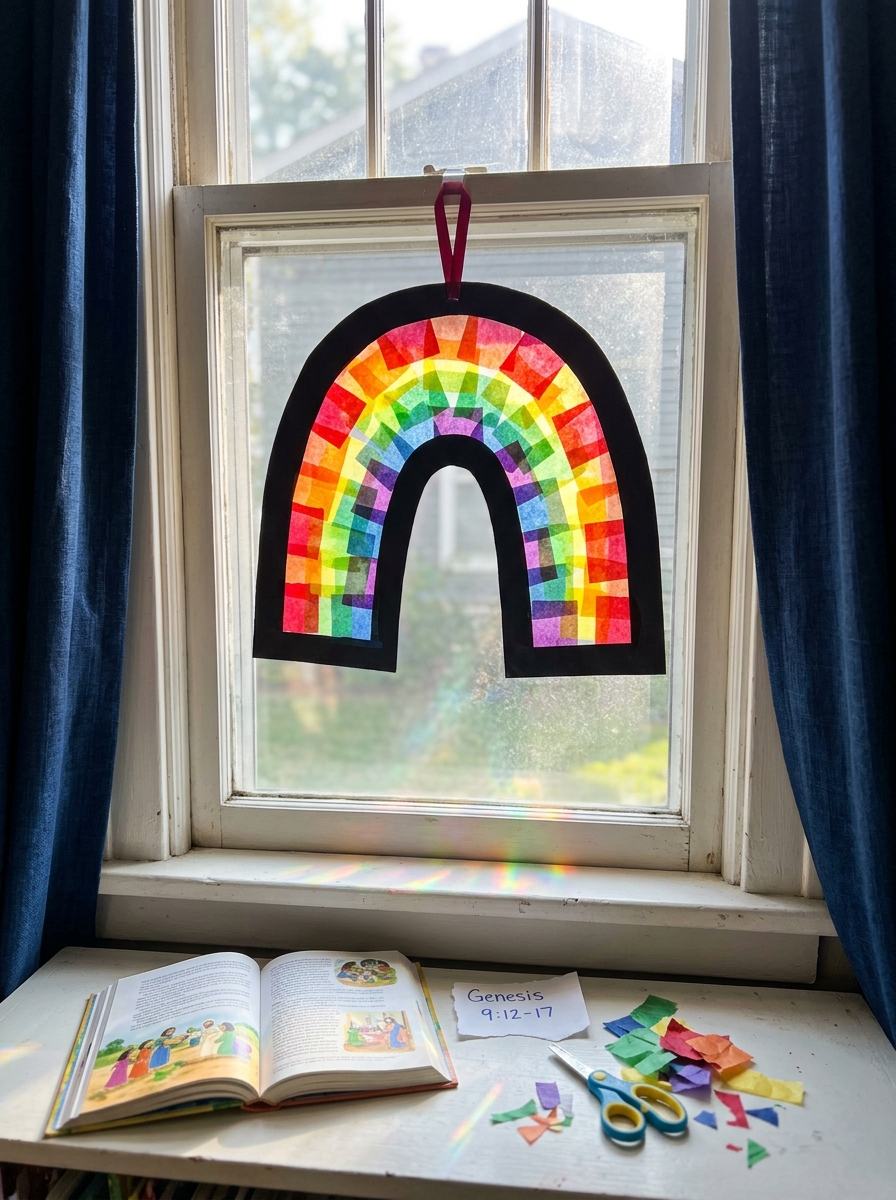
Bible passage: Genesis 9:12–17
The lesson: Remembering God’s covenant with Noah.
A rainbow suncatcher is a bright craft that introduces children to the story of Noah and God’s covenant. In Genesis 9, God places the rainbow as a sign of His covenant with Noah, his descendants, and every living creature after the flood.
It’s important to explain the passage accurately: the rainbow is a sign of God’s covenant in this particular biblical story, not a guarantee that people will never experience hardship.
Materials:
- Clear contact paper
- Colored tissue paper
- Black construction paper
- Pencil
- Scissors
- Optional ribbon
How to make it:
- Draw a large rainbow outline on black construction paper.
- Cut out the inside of the rainbow, leaving a black border.
- Cut small pieces of colored tissue paper.
- Place the rainbow frame on a sheet of clear contact paper.
- Fill the open rainbow sections with tissue paper pieces.
- Cover the back with another piece of contact paper.
- Trim the edges and attach it to a sunny window.
For younger children, prepare the rainbow frame in advance and let them arrange the tissue paper.
Talk about it: Retell the story of Noah and ask what the rainbow reminded Noah and his family about God’s covenant.
Age and time: Ages 4 and up with scissors assistance; approximately 25–35 minutes.
14. Armor of God Paper Shield
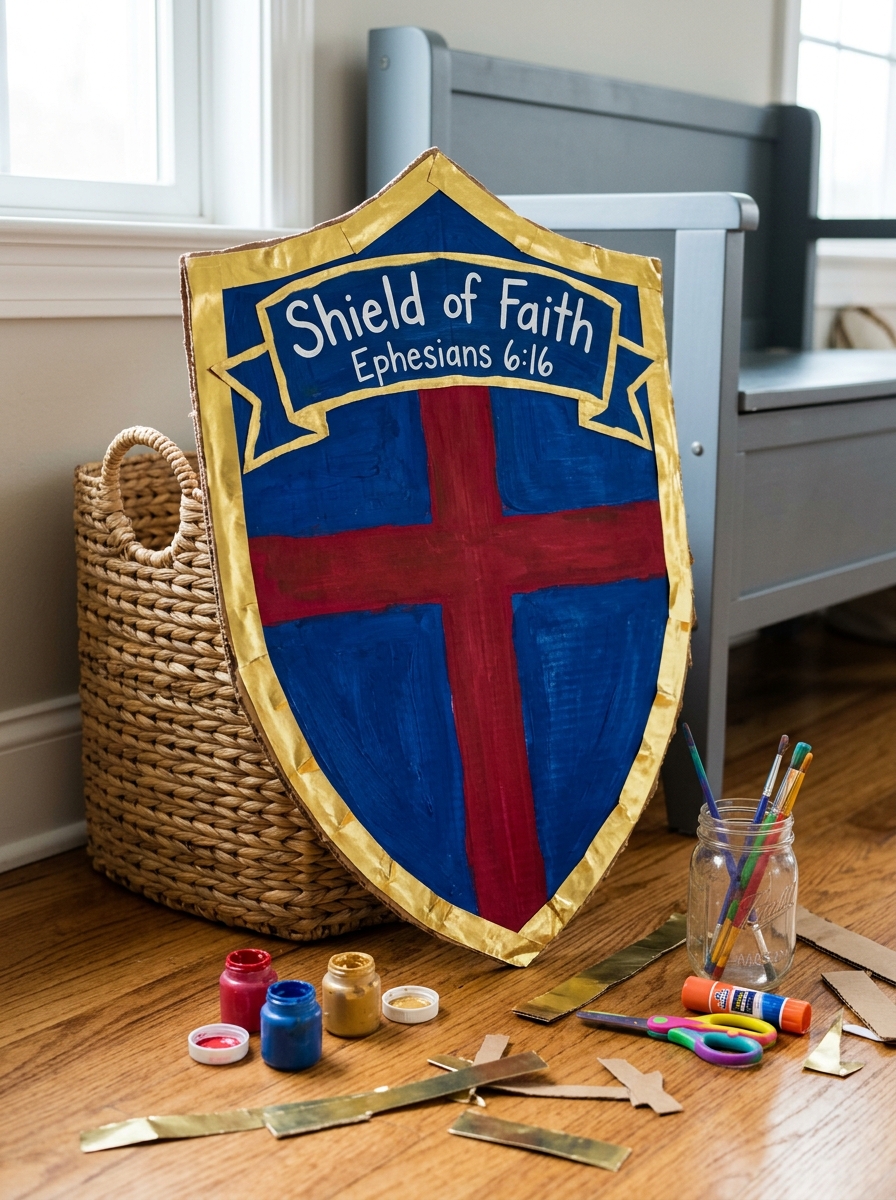
Bible passage: Ephesians 6:10–18
The lesson: Standing firm in faith.
Children can create a paper shield inspired by Paul’s description of the armor of God. The passage uses the image of a soldier’s armor to explain how believers can stand firm through truth, righteousness, faith, salvation, God’s Word, and prayer.
The shield is only one part of the passage: Paul specifically describes the shield of faith. The complete lesson includes several pieces of spiritual armor.
Materials:
- Cardboard from a cereal box
- Pencil
- Child-safe scissors
- Colored paper
- Glue
- Markers
- Optional paper strips for a handle
How to make it:
- Draw a simple shield shape on the cardboard.
- Cut it out, with adult help if the cardboard is thick.
- Cover the front with colored paper.
- Write “Shield of Faith” in the center.
- Add a Bible verse reference, Ephesians 6:16, and decorate the edges.
- Attach a paper handle to the back using strong tape or glue.
- Read Ephesians 6:10–18 and explain the other pieces of armor using simple examples.
For instance, truth means being honest, and the shoes of the gospel of peace remind believers to live and share God’s message of peace.
Talk about it: Ask what it means to stand firm in faith when making a difficult or unpopular choice.
Age and time: Ages 5 and up with adult assistance; approximately 25–35 minutes.
15. Kindness Character Crown
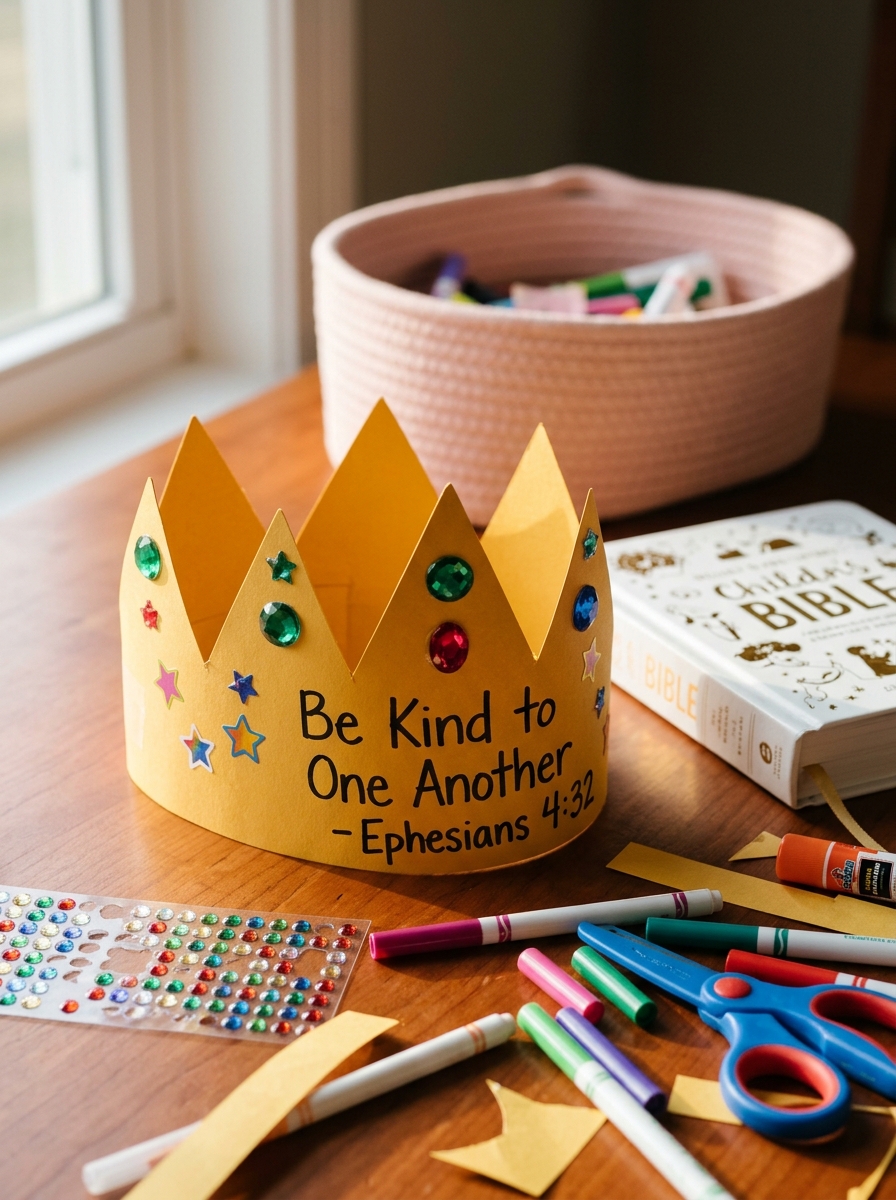
Bible passage: Colossians 3:12–14
The lesson: Choosing compassion, patience, forgiveness, and love.
A paper crown can help children remember the character qualities Paul encourages believers to practice. Colossians 3:12–14 tells Christians to clothe themselves with compassion, kindness, humility, gentleness, and patience, and to forgive one another. Above all, Paul emphasizes love.
Materials:
- Construction paper or cardstock
- Markers
- Scissors
- Glue stick or tape
- Stickers
- Optional decorative shapes
How to make it:
- Cut a long strip of cardstock wide enough to form a crown.
- Cut simple points along the top edge.
- Write one character quality from Colossians 3:12–14 on each section.
- Let your child decorate the crown with stars, hearts, or colorful patterns.
- Measure the strip around the child’s head and secure it with tape or glue.
- Read the passage together and discuss what each quality looks like in everyday life.
Rather than treating the crown as a prize for being perfectly kind, explain that these are qualities children can keep learning and practicing with God’s help.
Talk about it: Ask your child to choose one quality to practice this week, such as patience when sharing toys or kindness toward a classmate.
Age and time: Ages 4 and up; approximately 20–25 minutes.
How to Choose the Right New Year’s Bible Crafts for Kids
Not every craft is suitable for every age or group. A preschooler may enjoy decorating a gratitude quilt, while an older child may be ready to create a Scripture memory game or a twelve-month verse ring.
The best New Year’s Bible crafts for kids are those that match a child’s age, interests, and understanding of the Scripture lesson.
A few simple considerations can help you choose.
Start with your child’s age and abilities. Younger children usually do better with coloring, gluing, tracing, and decorating activities. Older children can handle more writing, cutting, and independent instructions.
Choose a lesson that fits the moment. If your family wants to focus on gratitude, try the paper quilt. If children are learning about prayer, make the prayer jar. For a Sunday school lesson about helping others, the Good Samaritan shoebox scene is a natural choice.
Use supplies you already have. Most projects can be made with construction paper, cardboard, markers, glue, and recycled containers. You don’t need to purchase a complete craft kit.
Consider the time available. A paper bracelet or handprint craft can fit into a short session. A shoebox Bible scene or a seed-growing project may need more preparation or follow-up.
Make room for conversation. The purpose is not to produce a perfect craft. Give children time to ask questions, talk about the Bible passage, and connect the lesson to something they experience in everyday life.
How to Use These Crafts at Home or in Sunday School
These New Year’s Bible crafts for kids can be adapted for family activities, homeschooling, and Sunday school with a little preparation.
At home: Choose one project for a family craft afternoon. Read the Bible passage first, make the craft together, and finish with a short conversation or prayer. You can display the finished project somewhere children will see it, such as a bedroom wall, refrigerator, or family noticeboard.
In Sunday school: Prepare materials before the children arrive. If you have a large group, divide children into smaller tables and choose a project that doesn’t require lengthy individual instructions. You can also prepare cutting templates in advance to keep the activity manageable.
For mixed-age groups: Let older children handle more detailed steps, such as writing verse references or cutting shapes, while younger children color, arrange, and glue. Give everyone a meaningful role rather than expecting all children to complete exactly the same version.
For a longer lesson: Use the craft as one part of a larger session. Read the Bible passage, tell the story in age-appropriate language, make the project, and ask children to share one thing they learned. A short prayer can help bring the lesson together.
For younger children, adults should supervise scissors, small decorations, planting materials, and any craft that uses adhesives or other potentially unsafe supplies. Keep small pieces away from children who may put them in their mouths.
If your children enjoy making things together during the holidays, you can also try our 10 Easy Christmas Crafts for Kids to Make at Home for more simple, creative projects.
Frequently Asked Questions
Which New Year’s Bible crafts for kids are easiest for beginners?
Easy options include a prayer jar, gratitude paper quilt, handprint craft, Scripture encouragement postcards, and Fruit of the Spirit paper bracelet. They use inexpensive materials and can be adapted for different ages.
What Bible verse is suitable for the beginning of a new year?
Several passages can help families reflect on a new beginning. Psalm 37:5 encourages trust in God, Philippians 4:6–7 teaches prayer and peace, and Colossians 2:6–7 describes growing in faith. Choose a passage based on the lesson you want children to understand.
How can I teach children about God through crafts?
Start by reading a short Bible passage and explaining its meaning in language children can understand. Let them make a craft that connects to the passage, then ask a simple question about how the lesson applies to everyday life. The conversation is just as important as the finished project.
Can these crafts be used for Sunday school?
Yes. Most of these projects can be adapted for Sunday school, children’s church, homeschool groups, or family activities. Prepare materials ahead of time, simplify instructions for younger children, and choose crafts that fit your available session time.
How can preschoolers participate in Bible crafts?
Choose activities with simple steps, such as decorating a prayer jar, making a handprint, arranging paper quilt squares, or coloring a crown. Adults can handle cutting and writing while children choose colors, glue shapes, and talk about the Bible lesson.
Welcome the New Year With Faith and Creativity
These New Year’s Bible crafts for kids don’t require complicated supplies or expensive activities. A few simple materials can help children explore important biblical lessons and create something meaningful together.
Choose one or two projects that suit your child’s age and interests. Read the Scripture together, make something with your hands, and take time to talk about how the lesson can shape the way you treat others, pray, and grow in faith throughout the year.